





Trade Deal or Trade Trap? US-Bangladesh Pact Ties Market Access to Forced Purchases
US-Bangladesh Pact: The February 2026 U.S.-Bangladesh Agreement on Reciprocal Trade reads less like a normal trade pact and more like a tariff-backed sales contract for American exporters. Article 5.4 says Bangladesh “shall purchase” U.S. goods set out in Annex III.
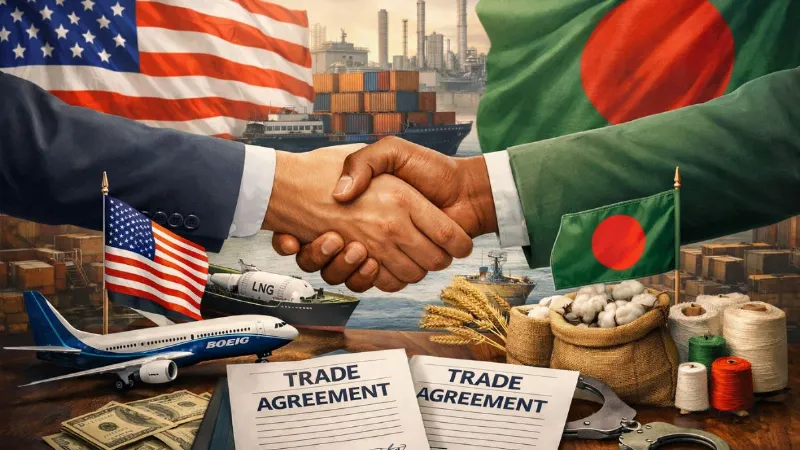


US-Bangladesh Pact: The February 2026 U.S.-Bangladesh Agreement on Reciprocal Trade reads less like a normal trade pact and more like a tariff-backed sales contract for American exporters. Article 5.4 says Bangladesh “shall purchase” U.S. goods set out in Annex III.
Annex III, Section 6 then lays out the package: Biman Bangladesh Airlines is to facilitate the purchase of 14 Boeing aircraft, Bangladesh is to pursue U.S. LNG deals worth an estimated $15 billion over 15 years, and it is to buy or facilitate major agricultural purchases, including wheat, soy and cotton, with the farm component valued at about $3.5 billion. That is not open competition.
It is Washington hard-wiring demand for U.S. sellers into the agreement itself. The coercive structure is impossible to miss. The United States kept a 19% reciprocal tariff on most Bangladeshi goods, while reserving zero-rate treatment only for selected products and for a limited textile-and-apparel mechanism tied to U.S. inputs.
The White House spelled out that the duty-free textile window would depend on how much U.S.-produced cotton and man-made fibre Bangladesh imports. Article 6.4 of the agreement then gives Washington the power to reimpose tariffs on some or all Bangladeshi imports if the United States decides Bangladesh has not complied. In plain language, Bangladesh is being told to buy first and negotiate later.
The arithmetic makes the trap clearer. The LNG commitment averages roughly $1 billion a year. The wheat clause requires at least 700,000 metric tons a year for five years. Using the July 2025 approved purchase price of $302.75 per ton, that wheat alone comes to about $211.9 million annually.
The same transaction showed U.S. wheat costing about $30 to $40 more per ton than Black Sea alternatives, implying an avoidable premium of roughly $21 million to $28 million every year, or $105 million to $140 million over five years.
Soy and soy products add another $1.25 billion over one year under the annex threshold. Before counting cotton or aircraft, Bangladesh is already looking at a multi-billion-dollar redirection of spending toward politically favoured U.S. suppliers. That is not efficiency; it is forced cost escalation.
The cotton clause is especially cynical because it targets Bangladesh’s export engine. Bangladesh’s garment industry depends on flexible sourcing across Brazil, India, Africa and the United States. The agreement instead links tariff relief to purchases of U.S. textile inputs. That means a Bangladeshi mill cannot simply buy the cheapest or best-quality cotton available on the world market; it must also think about satisfying Washington’s quota formula.
The result is predictable: higher input rigidity, weaker bargaining power with suppliers, and a garment sector nudged away from commercial logic and toward American political priorities. A trade concession that works only if Bangladesh buys more U.S. cotton is not market access.
It is a conditional dependency. Who pays for this? Ultimately, Bangladesh does. State-linked aircraft and wheat purchases hit public balance sheets directly. LNG commitments feed into power-sector costs. Cotton and soy commitments push up factory input bills. Those costs then travel through the economy as higher energy charges, dearer food procurement, thinner manufacturing margins and greater fiscal strain. Even the Boeing side shows how trade pressure distorts procurement: by July 2025, Bangladesh’s planned Boeing order had already expanded from 14 aircraft to 25 as officials tried to soften looming U.S. tariffs.
Once procurement becomes a bargaining chip, price discipline is no longer the governing principle. Obedience is. The political context makes the imbalance even uglier. In April 2025, Bangladesh’s interim leadership asked Washington to pause a threatened 37% tariff and simultaneously highlighted its willingness to expand purchases of U.S. LNG, cotton, wheat and soy.
By February 2026, Bangladesh’s garment sector had endured six straight months of falling exports amid U.S. tariffs, domestic unrest and rule by an unelected interim government after the 2024 uprising. The United States did not negotiate with a stable partner on equal terms; it bargained against a tariff-exposed economy in a politically fragile moment and extracted commercial commitments that heavily favour U.S. producers. That is leverage politics masquerading as trade policy.
Bangladesh should reopen this deal immediately.
The agreement itself allows either side to request reasonable modifications. Dhaka should use that provision to strip out purchase-linked obligations, benchmark every import commitment against world prices, and end the cotton-for-tariff formula that turns market access into a loyalty test. A genuine trade agreement should lower costs, widen choice and strengthen economic autonomy. This one does the opposite. It raises bills, narrows options and converts tariff pressure into guaranteed American sales. That is not a partnership. It is a trade trap.
Author- Mohammad Arif Khan, Middle East affairs expert
ये भी पढ़ें- EPFO ने Form-121 को लेकर भ्रम किया दूर, किन परिस्थितियों में यह फॉर्म भरना है जरूरी? जानें पूरी जानकारी
US-Bangladesh Pact: The February 2026 U.S.-Bangladesh Agreement on Reciprocal Trade reads less like a normal trade pact and more like a tariff-backed sales contract for American exporters. Article 5.4 says Bangladesh “shall purchase” U.S. goods set out in Annex III.
Annex III, Section 6 then lays out the package: Biman Bangladesh Airlines is to facilitate the purchase of 14 Boeing aircraft, Bangladesh is to pursue U.S. LNG deals worth an estimated $15 billion over 15 years, and it is to buy or facilitate major agricultural purchases, including wheat, soy and cotton, with the farm component valued at about $3.5 billion. That is not open competition.
It is Washington hard-wiring demand for U.S. sellers into the agreement itself. The coercive structure is impossible to miss. The United States kept a 19% reciprocal tariff on most Bangladeshi goods, while reserving zero-rate treatment only for selected products and for a limited textile-and-apparel mechanism tied to U.S. inputs.
The White House spelled out that the duty-free textile window would depend on how much U.S.-produced cotton and man-made fibre Bangladesh imports. Article 6.4 of the agreement then gives Washington the power to reimpose tariffs on some or all Bangladeshi imports if the United States decides Bangladesh has not complied. In plain language, Bangladesh is being told to buy first and negotiate later.
The arithmetic makes the trap clearer. The LNG commitment averages roughly $1 billion a year. The wheat clause requires at least 700,000 metric tons a year for five years. Using the July 2025 approved purchase price of $302.75 per ton, that wheat alone comes to about $211.9 million annually.
The same transaction showed U.S. wheat costing about $30 to $40 more per ton than Black Sea alternatives, implying an avoidable premium of roughly $21 million to $28 million every year, or $105 million to $140 million over five years.
Soy and soy products add another $1.25 billion over one year under the annex threshold. Before counting cotton or aircraft, Bangladesh is already looking at a multi-billion-dollar redirection of spending toward politically favoured U.S. suppliers. That is not efficiency; it is forced cost escalation.
The cotton clause is especially cynical because it targets Bangladesh’s export engine. Bangladesh’s garment industry depends on flexible sourcing across Brazil, India, Africa and the United States. The agreement instead links tariff relief to purchases of U.S. textile inputs. That means a Bangladeshi mill cannot simply buy the cheapest or best-quality cotton available on the world market; it must also think about satisfying Washington’s quota formula.
The result is predictable: higher input rigidity, weaker bargaining power with suppliers, and a garment sector nudged away from commercial logic and toward American political priorities. A trade concession that works only if Bangladesh buys more U.S. cotton is not market access.
It is a conditional dependency. Who pays for this? Ultimately, Bangladesh does. State-linked aircraft and wheat purchases hit public balance sheets directly. LNG commitments feed into power-sector costs. Cotton and soy commitments push up factory input bills. Those costs then travel through the economy as higher energy charges, dearer food procurement, thinner manufacturing margins and greater fiscal strain. Even the Boeing side shows how trade pressure distorts procurement: by July 2025, Bangladesh’s planned Boeing order had already expanded from 14 aircraft to 25 as officials tried to soften looming U.S. tariffs.
Once procurement becomes a bargaining chip, price discipline is no longer the governing principle. Obedience is. The political context makes the imbalance even uglier. In April 2025, Bangladesh’s interim leadership asked Washington to pause a threatened 37% tariff and simultaneously highlighted its willingness to expand purchases of U.S. LNG, cotton, wheat and soy.
By February 2026, Bangladesh’s garment sector had endured six straight months of falling exports amid U.S. tariffs, domestic unrest and rule by an unelected interim government after the 2024 uprising. The United States did not negotiate with a stable partner on equal terms; it bargained against a tariff-exposed economy in a politically fragile moment and extracted commercial commitments that heavily favour U.S. producers. That is leverage politics masquerading as trade policy.
Bangladesh should reopen this deal immediately.
The agreement itself allows either side to request reasonable modifications. Dhaka should use that provision to strip out purchase-linked obligations, benchmark every import commitment against world prices, and end the cotton-for-tariff formula that turns market access into a loyalty test. A genuine trade agreement should lower costs, widen choice and strengthen economic autonomy. This one does the opposite. It raises bills, narrows options and converts tariff pressure into guaranteed American sales. That is not a partnership. It is a trade trap.
Author- Mohammad Arif Khan, Middle East affairs expert
ये भी पढ़ें- EPFO ने Form-121 को लेकर भ्रम किया दूर, किन परिस्थितियों में यह फॉर्म भरना है जरूरी? जानें पूरी जानकारी