





MoD PSU HSL Gets Strategic Vote of Confidence from the Navy, Expands Its Role Beyond Shipbuilding
The Indian Navy has outlined a broader strategic role for Defence Ministry Miniratna PSU Hindustan Shipyard Limited (HSL).
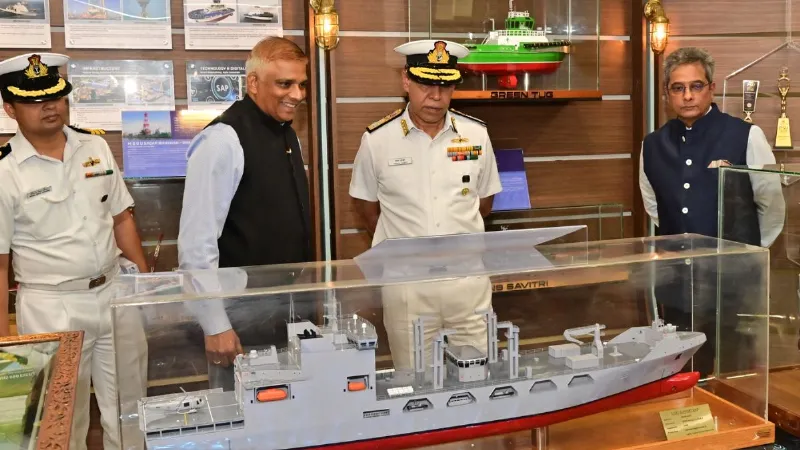


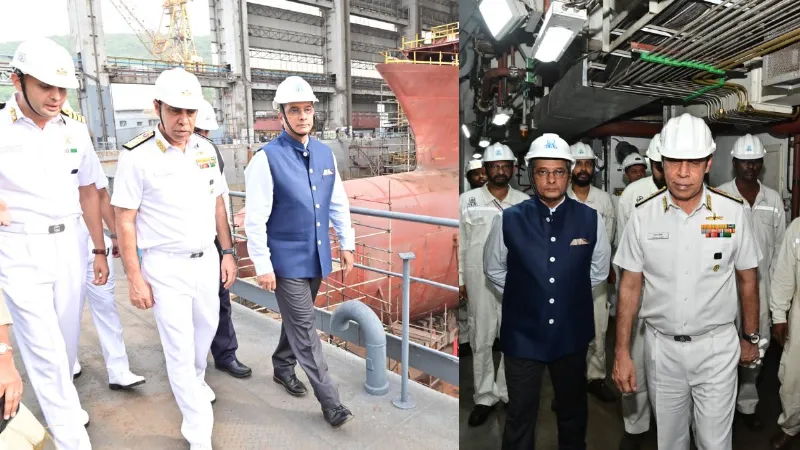
The Indian Navy has outlined a broader strategic role for Defence Ministry Miniratna PSU Hindustan Shipyard Limited (HSL). During his visit to the Visakhapatnam-based shipyard on July 6, Deputy Chief of the Naval Staff (DCNS) Vice Admiral Tarun Sobti said the Navy wants HSL to evolve beyond a conventional shipbuilder into a strategic partner providing full lifecycle support, upgrades and mid-life modernisation. After reviewing the shipyard's ongoing projects and infrastructure modernisation in a briefing by Chairman and Managing Director Rear Admiral Chandrasekharan Raghuram (Retd.), the DCNS underscored that the expanded role would hinge on two fundamentals: quality and timely delivery.
Vice Admiral Tarun Sobti described HSL, a Mini Ratna Category-I Defence Ministry PSU, as having "been a trusted partner of the Indian Navy for a very long time" and predicted that "along with the Indian Navy, HSL will be a very, very important part" of the country's growing maritime sector. But the weight he placed on delivery suggested that the forecast was conditional, not guaranteed.
strategic partner of the Indian Navy
He was similarly direct about what underpins execution capacity: workforce experience, not infrastructure. "HSL has acquired a certain amount of experience," he said, expressing confidence that the shipyard would continue to expand its capabilities and strengthen its role as a strategic partner of the Indian Navy — a statement of confidence that nonetheless reads as tied to continued performance rather than assumed by default.
HSL's track record gives the Navy grounds for that confidence but also shows why the execution bar matters. The yard has carried out extended medium refits of Kilo-class submarines, including INS Sindhukirti, INS Vela and INS Vagli — with the Sindhukirti's medium refit and modernisation currently under way — and earlier retrofitted INS Sindhuvir before its transfer to Myanmar, a body of work that demonstrates capability but also underscores how much complex, time-bound execution the "strategic partner" mandate will demand at scale.
The DCNS's statement that the Navy would like "to partner with HSL as a strategic partner and not just a construction yard" effectively raises the stakes on execution rather than lowering them: a construction yard is judged on individual deliveries, but a strategic partner's failures compound across an entire, long-running relationship.
HSL's Mini Ratna status – giving its board autonomy over capital expenditure and technology tie-ups, including its collaboration with Mazagon Dock Shipbuilders Limited to expand from submarine refits into construction – removes one layer of bureaucratic friction from execution but does not substitute for the operational discipline the DCNS was explicitly asking for.
Read together, the remarks suggest the Navy's elevation of HSL to strategic partner status is less a reward for past performance than a wager on future consistency – one the DCNS made clear will be judged, quite literally, delivery by delivery.
The Indian Navy has outlined a broader strategic role for Defence Ministry Miniratna PSU Hindustan Shipyard Limited (HSL). During his visit to the Visakhapatnam-based shipyard on July 6, Deputy Chief of the Naval Staff (DCNS) Vice Admiral Tarun Sobti said the Navy wants HSL to evolve beyond a conventional shipbuilder into a strategic partner providing full lifecycle support, upgrades and mid-life modernisation. After reviewing the shipyard's ongoing projects and infrastructure modernisation in a briefing by Chairman and Managing Director Rear Admiral Chandrasekharan Raghuram (Retd.), the DCNS underscored that the expanded role would hinge on two fundamentals: quality and timely delivery.
Vice Admiral Tarun Sobti described HSL, a Mini Ratna Category-I Defence Ministry PSU, as having "been a trusted partner of the Indian Navy for a very long time" and predicted that "along with the Indian Navy, HSL will be a very, very important part" of the country's growing maritime sector. But the weight he placed on delivery suggested that the forecast was conditional, not guaranteed.
strategic partner of the Indian Navy
He was similarly direct about what underpins execution capacity: workforce experience, not infrastructure. "HSL has acquired a certain amount of experience," he said, expressing confidence that the shipyard would continue to expand its capabilities and strengthen its role as a strategic partner of the Indian Navy — a statement of confidence that nonetheless reads as tied to continued performance rather than assumed by default.
HSL's track record gives the Navy grounds for that confidence but also shows why the execution bar matters. The yard has carried out extended medium refits of Kilo-class submarines, including INS Sindhukirti, INS Vela and INS Vagli — with the Sindhukirti's medium refit and modernisation currently under way — and earlier retrofitted INS Sindhuvir before its transfer to Myanmar, a body of work that demonstrates capability but also underscores how much complex, time-bound execution the "strategic partner" mandate will demand at scale.
The DCNS's statement that the Navy would like "to partner with HSL as a strategic partner and not just a construction yard" effectively raises the stakes on execution rather than lowering them: a construction yard is judged on individual deliveries, but a strategic partner's failures compound across an entire, long-running relationship.
HSL's Mini Ratna status – giving its board autonomy over capital expenditure and technology tie-ups, including its collaboration with Mazagon Dock Shipbuilders Limited to expand from submarine refits into construction – removes one layer of bureaucratic friction from execution but does not substitute for the operational discipline the DCNS was explicitly asking for.
Read together, the remarks suggest the Navy's elevation of HSL to strategic partner status is less a reward for past performance than a wager on future consistency – one the DCNS made clear will be judged, quite literally, delivery by delivery.