





Saudi Arabia, the UAE, and Where the Current Gulf Crisis May Lead
The current divergence between Saudi Arabia and the United Arab Emirates has moved beyond a temporary tactical disagreement and now looks like a structural contest over ideology, oil governance, regional influence, and relations with outside powers.


Author- Mohammad Arif Khan, Middle East affairs expert
The current divergence between Saudi Arabia and the United Arab Emirates has moved beyond a temporary tactical disagreement and now looks like a structural contest over ideology, oil governance, regional influence, and relations with outside powers. Saudi Arabia is still trying to preserve a more controlled regional order centered on long-term state planning, OPEC coordination, and disciplined use of oil rents, while the UAE is acting with greater speed, commercial pragmatism, and willingness to bypass older collective frameworks when they limit its room for maneuver.
The most important question now is no longer whether the two states differ, but where this divergence could lead the wider Gulf region over the next several years.
Ideological divergence and competing state models
Saudi Arabia historically drew legitimacy from a conservative religious establishment, and although Crown Prince Mohammed bin Salman has promoted a more moderate public image, the Saudi system still carries the institutional legacy of a tightly managed religious order. The UAE, by contrast, has built a state-directed, secular-leaning model that brands itself as tolerant, anti-Islamist, and investor-friendly, while treating political Islam as a direct challenge to regime stability. These differences shape not only domestic governance but also how each state defines acceptable allies, threats, and models of regional order.
For Abu Dhabi, stability means limiting ideological actors, suppressing transnational Islamist networks, and marketing the country as a dependable business and security hub. For Riyadh, stability still depends more on central control and gradual top-down reform that does not fully detach the state from its traditional conservative foundations. Over time, this ideological mismatch could deepen policy divergence across the Arab world, particularly in places where Islamists, military rulers, tribal actors, and foreign-backed militias compete for influence.
Oil dependence remains the hard limit
Despite diversification efforts, both Saudi Arabia and the UAE remain heavily dependent on hydrocarbons. In Saudi Arabia, oil and gas still contribute roughly 22 to 23 percent of GDP, around 55 percent of government revenue, and the vast majority of export earnings In the UAE, hydrocarbons contribute about 30 percent of GDP and a majority of public revenue, with Abu Dhabi carrying most of the federation's oil exposure despite Dubai's more diversified profile.
This means that any decline in production, sales, or prices can directly hamper the needs of the state. Lower oil income weakens the ability to fund salaries, subsidies, housing, infrastructure, mega-projects, sovereign wealth deployment, and foreign-policy activism. In Saudi Arabia, sustained oil weakness threatens the financing logic of Vision 2030 and may force delays to large prestige projects intended to anchor long-term domestic legitimacy. In the UAE, a revenue squeeze would narrow the capital available for external leverage, strategic investments, and the financial tools it uses in countries such as Egypt and Pakistan.
Immediate-profit UAE versus long-horizon Saudi control
The economic disagreement between the two states is also a disagreement over timing. The UAE increasingly favors an immediate-profit model that seeks flexibility in production, faster monetization of assets, and freedom from restrictive quota systems. This approach fits Abu Dhabi's broader ambition to use energy wealth quickly in order to reinforce its role in logistics, ports, technology, finance, and strategic acquisitions.
Saudi Arabia, in contrast, prefers controlled output and coordinated market signaling through institutions such as OPEC, because it wants to preserve pricing power while using oil rents to finance a long transition into a post-oil economy. Riyadh's model is less flexible in the short term, but it is designed to retain strategic weight by preventing price collapses and preserving central influence over the global oil market. This difference over whether to maximize near-term revenue or conserve long-term leverage is one of the core drivers of Gulf tension.
The UAE, Israel, and the new Gulf security pattern
The UAE's relationship with Israel illustrates how far Abu Dhabi has moved toward hard pragmatism. Since normalization, the UAE has treated Israel as a useful security and technology partner in areas such as intelligence, missile defense, and advanced military systems. Reports during the recent war environment pointing to Israeli defensive deployment and closer military coordination in the UAE show that Abu Dhabi is prepared to absorb regional criticism if doing so increases deterrence against Iran and allied armed groups.
This approach could shape the wider Gulf security order in the future. If the UAE continues moving closer to Israel on defense, and if Saudi Arabia remains more cautious or conditional, the Gulf may evolve toward an uneven security structure in which some states integrate quietly with Israel while others keep more symbolic distance. That would add another layer of fragmentation to an already divided regional system.
Strategic shifts in Syria, Lebanon, Egypt, and Yemen
The UAE has built influence across fragile Arab states not through broad ideological leadership but through selective control of strategic nodes. In Syria, it has supported Arab re-engagement partly to shape the political field and reduce exclusive Iranian influence. In Lebanon, it has preferred anti-Hezbollah and non-Islamist alignments where possible. In Egypt, it remains one of the principal financial backers of President Abdel Fattah el-Sisi and sees Cairo as a central pillar in the anti-Islamist regional order.
Yemen remains the clearest example of divergence with Saudi Arabia. Abu Dhabi's backing of southern and local armed actors has strengthened its hold over ports and maritime routes, but it has also complicated Saudi attempts to preserve a broader coalition structure. This pattern suggests that future Gulf competition may increasingly be fought through local proxies, financial patronage, port access, and technology partnerships rather than through overt bloc-wide consensus.
OPEC exit and the weakening of collective Gulf discipline
The UAE's exit from OPEC is one of the most significant indicators that Gulf politics is shifting from coordination to managed competition. Officially, Abu Dhabi has framed the move as a strategic energy shift aimed at using its full production capacity more effectively. In practical terms, it also shows that the UAE is willing to place sovereign commercial advantage above bloc discipline and above the symbolism of Gulf unanimity.
This could have long-term consequences for the Gulf Cooperation Council. The GCC has always contained rivalries, but its strength depended on the appearance of strategic coherence on the biggest questions of oil, security, and regional diplomacy. If Saudi Arabia and the UAE continue to separate on these fronts, the GCC may survive institutionally but operate more as a loose umbrella than as a unified strategic alliance.
Pakistan, leverage, and differentiated Gulf power
Pakistan reveals how differently Riyadh and Abu Dhabi now project power. Saudi Arabia continues to value Pakistan through a security lens, relying on military ties, strategic familiarity, and long-standing defense cooperation. The UAE, meanwhile, has shown readiness to use finance as coercive leverage, including pressure linked to repayment of large loans and deposits during a highly unstable regional moment.
This divergence matters because it suggests that future Gulf influence will be exercised through different toolkits. Riyadh is likely to remain stronger in traditional state-to-state security bargains, while Abu Dhabi may remain more agile in using capital, debt, ports, logistics, and investment structures to shape outcomes. Countries such as Pakistan, Egypt, and smaller Red Sea or Horn of Africa states may increasingly find themselves balancing between Saudi security guarantees and Emirati financial leverage.
Trump, the Gulf vacuum, and the politics of widening gaps
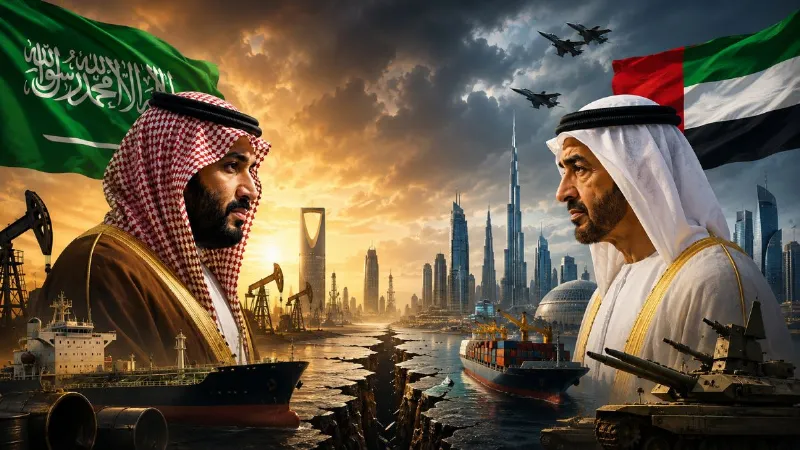
The widening distance between MBZ and MBS creates a strategic opening for President Donald Trump. When Riyadh and Abu Dhabi fail to act as a coherent axis, Washington gains room to arbitrate disputes, extract concessions, and deal with each side separately on defense, investment, and diplomacy. In this sense, the vacuum between MBZ and MBS does not merely invite American involvement; it increases the value of American involvement.
There is also a more forceful interpretation. Trump can benefit not only by filling the blank between Saudi Arabia and the UAE but also by allowing that blank to widen, because a larger gap creates stronger justification for US pressure, arms deals, security deployments, and direct intervention. Reports that he relayed inflammatory messages between Gulf leaders underscore how personalized diplomacy can simultaneously deepen mistrust and make Washington seem indispensable. The more divided the Gulf becomes, the easier it is for the United States to act as both referee and strategic beneficiary.
Where the current crisis may lead the Gulf region
Several plausible future paths emerge from the current crisis. The first is a managed rivalry in which Saudi Arabia and the UAE avoid open confrontation but continue competing across oil, ports, investment corridors, fragile Arab states, and access to Washington. This is the most likely near-term outcome because both sides still benefit from avoiding a complete breakdown while preserving room to outmaneuver one another.
A second path is deeper fragmentation of Gulf strategic order. Under this scenario, the GCC would remain formally intact but lose practical cohesion, with member states aligning differently on Iran, Israel, energy production, and intervention in regional conflicts. Such a shift would make the Gulf more vulnerable to external manipulation by larger powers including the United States, and potentially by China and other external economic actors seeking bilateral advantage.
A third possibility is selective re-coordination under pressure. A severe oil-price shock, a large-scale regional war, or direct attacks on Gulf energy infrastructure could force Riyadh and Abu Dhabi back toward tactical cooperation because both states remain exposed to the same oil-linked vulnerabilities. In that case, reconciliation would likely be functional rather than genuine, driven by fear and shared necessity rather than restored trust.
A fourth and more destabilizing future is a Gulf region increasingly divided into overlapping mini-axes. One axis could revolve around Saudi-led security coordination with states such as Pakistan, while another could center on UAE-led financial, maritime, and technology networks tied to Israel and other external partners. If this happens, the Gulf would no longer operate as a single political theater but as a competitive arena in which alliances become issue-specific and temporary.
The broader regional consequences
If current trends continue, the Gulf will likely become less unified but more interventionist. Rather than acting through a single shared doctrine, Gulf powers may expand influence through competing investments, local militias, intelligence partnerships, energy deals, and security technologies across the Middle East and the Red Sea basin. This would produce a region that is not necessarily in open war, but is more fragmented, more transactional, and more vulnerable to repeated crises.
The strongest limiting factor remains oil dependence. Both Saudi Arabia and the UAE are trying to project power as future-oriented states, but they are still sustained by hydrocarbon rents in the present. If production falls, prices weaken, or exports are disrupted, their capacity to maintain domestic stability and regional ambition will shrink sharply. In that sense, the future of the Gulf will be shaped not only by rivalry between MBS and MBZ, but also by how long oil can continue financing that rivalry.
Conclusion
The current Gulf crisis points toward a region that is entering a new phase of competitive coexistence. Saudi Arabia and the UAE are not simply disagreeing over tactics; they are advancing partially different models of order, alliance, and economic timing. As their rivalry hardens, the GCC risks becoming looser, external actors such as the United States gain greater leverage, and countries across the Arab world may face more selective but more intense Gulf intervention. Unless a major external shock forces genuine re-coordination, the most likely outcome is a Gulf region that remains wealthy and influential, but also more divided, more personalized in leadership, and more unstable beneath the surface of formal diplomacy.
Author- Mohammad Arif Khan, Middle East affairs expert
The current divergence between Saudi Arabia and the United Arab Emirates has moved beyond a temporary tactical disagreement and now looks like a structural contest over ideology, oil governance, regional influence, and relations with outside powers. Saudi Arabia is still trying to preserve a more controlled regional order centered on long-term state planning, OPEC coordination, and disciplined use of oil rents, while the UAE is acting with greater speed, commercial pragmatism, and willingness to bypass older collective frameworks when they limit its room for maneuver.
The most important question now is no longer whether the two states differ, but where this divergence could lead the wider Gulf region over the next several years.
Ideological divergence and competing state models
Saudi Arabia historically drew legitimacy from a conservative religious establishment, and although Crown Prince Mohammed bin Salman has promoted a more moderate public image, the Saudi system still carries the institutional legacy of a tightly managed religious order. The UAE, by contrast, has built a state-directed, secular-leaning model that brands itself as tolerant, anti-Islamist, and investor-friendly, while treating political Islam as a direct challenge to regime stability. These differences shape not only domestic governance but also how each state defines acceptable allies, threats, and models of regional order.
For Abu Dhabi, stability means limiting ideological actors, suppressing transnational Islamist networks, and marketing the country as a dependable business and security hub. For Riyadh, stability still depends more on central control and gradual top-down reform that does not fully detach the state from its traditional conservative foundations. Over time, this ideological mismatch could deepen policy divergence across the Arab world, particularly in places where Islamists, military rulers, tribal actors, and foreign-backed militias compete for influence.
Oil dependence remains the hard limit
Despite diversification efforts, both Saudi Arabia and the UAE remain heavily dependent on hydrocarbons. In Saudi Arabia, oil and gas still contribute roughly 22 to 23 percent of GDP, around 55 percent of government revenue, and the vast majority of export earnings In the UAE, hydrocarbons contribute about 30 percent of GDP and a majority of public revenue, with Abu Dhabi carrying most of the federation's oil exposure despite Dubai's more diversified profile.
This means that any decline in production, sales, or prices can directly hamper the needs of the state. Lower oil income weakens the ability to fund salaries, subsidies, housing, infrastructure, mega-projects, sovereign wealth deployment, and foreign-policy activism. In Saudi Arabia, sustained oil weakness threatens the financing logic of Vision 2030 and may force delays to large prestige projects intended to anchor long-term domestic legitimacy. In the UAE, a revenue squeeze would narrow the capital available for external leverage, strategic investments, and the financial tools it uses in countries such as Egypt and Pakistan.
Immediate-profit UAE versus long-horizon Saudi control
The economic disagreement between the two states is also a disagreement over timing. The UAE increasingly favors an immediate-profit model that seeks flexibility in production, faster monetization of assets, and freedom from restrictive quota systems. This approach fits Abu Dhabi's broader ambition to use energy wealth quickly in order to reinforce its role in logistics, ports, technology, finance, and strategic acquisitions.
Saudi Arabia, in contrast, prefers controlled output and coordinated market signaling through institutions such as OPEC, because it wants to preserve pricing power while using oil rents to finance a long transition into a post-oil economy. Riyadh's model is less flexible in the short term, but it is designed to retain strategic weight by preventing price collapses and preserving central influence over the global oil market. This difference over whether to maximize near-term revenue or conserve long-term leverage is one of the core drivers of Gulf tension.
The UAE, Israel, and the new Gulf security pattern
The UAE's relationship with Israel illustrates how far Abu Dhabi has moved toward hard pragmatism. Since normalization, the UAE has treated Israel as a useful security and technology partner in areas such as intelligence, missile defense, and advanced military systems. Reports during the recent war environment pointing to Israeli defensive deployment and closer military coordination in the UAE show that Abu Dhabi is prepared to absorb regional criticism if doing so increases deterrence against Iran and allied armed groups.
This approach could shape the wider Gulf security order in the future. If the UAE continues moving closer to Israel on defense, and if Saudi Arabia remains more cautious or conditional, the Gulf may evolve toward an uneven security structure in which some states integrate quietly with Israel while others keep more symbolic distance. That would add another layer of fragmentation to an already divided regional system.
Strategic shifts in Syria, Lebanon, Egypt, and Yemen
The UAE has built influence across fragile Arab states not through broad ideological leadership but through selective control of strategic nodes. In Syria, it has supported Arab re-engagement partly to shape the political field and reduce exclusive Iranian influence. In Lebanon, it has preferred anti-Hezbollah and non-Islamist alignments where possible. In Egypt, it remains one of the principal financial backers of President Abdel Fattah el-Sisi and sees Cairo as a central pillar in the anti-Islamist regional order.
Yemen remains the clearest example of divergence with Saudi Arabia. Abu Dhabi's backing of southern and local armed actors has strengthened its hold over ports and maritime routes, but it has also complicated Saudi attempts to preserve a broader coalition structure. This pattern suggests that future Gulf competition may increasingly be fought through local proxies, financial patronage, port access, and technology partnerships rather than through overt bloc-wide consensus.
OPEC exit and the weakening of collective Gulf discipline
The UAE's exit from OPEC is one of the most significant indicators that Gulf politics is shifting from coordination to managed competition. Officially, Abu Dhabi has framed the move as a strategic energy shift aimed at using its full production capacity more effectively. In practical terms, it also shows that the UAE is willing to place sovereign commercial advantage above bloc discipline and above the symbolism of Gulf unanimity.
This could have long-term consequences for the Gulf Cooperation Council. The GCC has always contained rivalries, but its strength depended on the appearance of strategic coherence on the biggest questions of oil, security, and regional diplomacy. If Saudi Arabia and the UAE continue to separate on these fronts, the GCC may survive institutionally but operate more as a loose umbrella than as a unified strategic alliance.
Pakistan, leverage, and differentiated Gulf power
Pakistan reveals how differently Riyadh and Abu Dhabi now project power. Saudi Arabia continues to value Pakistan through a security lens, relying on military ties, strategic familiarity, and long-standing defense cooperation. The UAE, meanwhile, has shown readiness to use finance as coercive leverage, including pressure linked to repayment of large loans and deposits during a highly unstable regional moment.
This divergence matters because it suggests that future Gulf influence will be exercised through different toolkits. Riyadh is likely to remain stronger in traditional state-to-state security bargains, while Abu Dhabi may remain more agile in using capital, debt, ports, logistics, and investment structures to shape outcomes. Countries such as Pakistan, Egypt, and smaller Red Sea or Horn of Africa states may increasingly find themselves balancing between Saudi security guarantees and Emirati financial leverage.
Trump, the Gulf vacuum, and the politics of widening gaps
The widening distance between MBZ and MBS creates a strategic opening for President Donald Trump. When Riyadh and Abu Dhabi fail to act as a coherent axis, Washington gains room to arbitrate disputes, extract concessions, and deal with each side separately on defense, investment, and diplomacy. In this sense, the vacuum between MBZ and MBS does not merely invite American involvement; it increases the value of American involvement.
There is also a more forceful interpretation. Trump can benefit not only by filling the blank between Saudi Arabia and the UAE but also by allowing that blank to widen, because a larger gap creates stronger justification for US pressure, arms deals, security deployments, and direct intervention. Reports that he relayed inflammatory messages between Gulf leaders underscore how personalized diplomacy can simultaneously deepen mistrust and make Washington seem indispensable. The more divided the Gulf becomes, the easier it is for the United States to act as both referee and strategic beneficiary.
Where the current crisis may lead the Gulf region
Several plausible future paths emerge from the current crisis. The first is a managed rivalry in which Saudi Arabia and the UAE avoid open confrontation but continue competing across oil, ports, investment corridors, fragile Arab states, and access to Washington. This is the most likely near-term outcome because both sides still benefit from avoiding a complete breakdown while preserving room to outmaneuver one another.
A second path is deeper fragmentation of Gulf strategic order. Under this scenario, the GCC would remain formally intact but lose practical cohesion, with member states aligning differently on Iran, Israel, energy production, and intervention in regional conflicts. Such a shift would make the Gulf more vulnerable to external manipulation by larger powers including the United States, and potentially by China and other external economic actors seeking bilateral advantage.
A third possibility is selective re-coordination under pressure. A severe oil-price shock, a large-scale regional war, or direct attacks on Gulf energy infrastructure could force Riyadh and Abu Dhabi back toward tactical cooperation because both states remain exposed to the same oil-linked vulnerabilities. In that case, reconciliation would likely be functional rather than genuine, driven by fear and shared necessity rather than restored trust.
A fourth and more destabilizing future is a Gulf region increasingly divided into overlapping mini-axes. One axis could revolve around Saudi-led security coordination with states such as Pakistan, while another could center on UAE-led financial, maritime, and technology networks tied to Israel and other external partners. If this happens, the Gulf would no longer operate as a single political theater but as a competitive arena in which alliances become issue-specific and temporary.
The broader regional consequences
If current trends continue, the Gulf will likely become less unified but more interventionist. Rather than acting through a single shared doctrine, Gulf powers may expand influence through competing investments, local militias, intelligence partnerships, energy deals, and security technologies across the Middle East and the Red Sea basin. This would produce a region that is not necessarily in open war, but is more fragmented, more transactional, and more vulnerable to repeated crises.
The strongest limiting factor remains oil dependence. Both Saudi Arabia and the UAE are trying to project power as future-oriented states, but they are still sustained by hydrocarbon rents in the present. If production falls, prices weaken, or exports are disrupted, their capacity to maintain domestic stability and regional ambition will shrink sharply. In that sense, the future of the Gulf will be shaped not only by rivalry between MBS and MBZ, but also by how long oil can continue financing that rivalry.
Conclusion
The current Gulf crisis points toward a region that is entering a new phase of competitive coexistence. Saudi Arabia and the UAE are not simply disagreeing over tactics; they are advancing partially different models of order, alliance, and economic timing. As their rivalry hardens, the GCC risks becoming looser, external actors such as the United States gain greater leverage, and countries across the Arab world may face more selective but more intense Gulf intervention. Unless a major external shock forces genuine re-coordination, the most likely outcome is a Gulf region that remains wealthy and influential, but also more divided, more personalized in leadership, and more unstable beneath the surface of formal diplomacy.