





Pakistan Navy is a force that can watch its own coast, and not much further
When a missile strike hit the Tanzania-flagged cargo vessel Tihamah near the Bab al-Mandeb Strait on August 11, it did more than add another name to the grim ledger of Houthi attacks on commercial shipping.
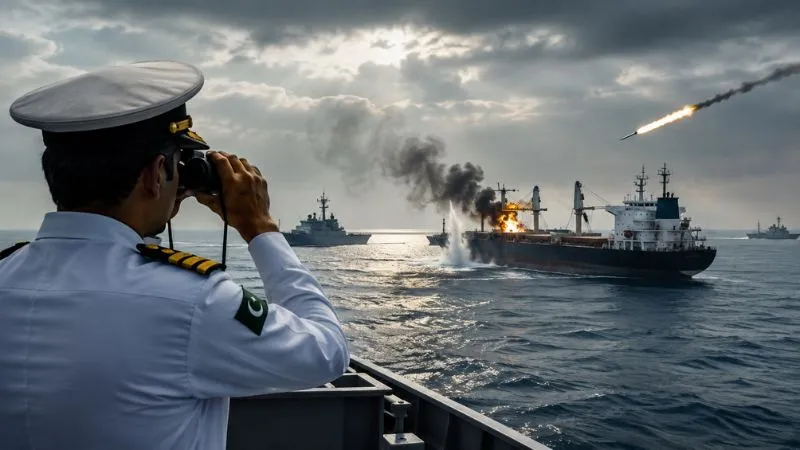


When a missile strike hit the Tanzania-flagged cargo vessel Tihamah near the Bab al-Mandeb Strait on August 11, it did more than add another name to the grim ledger of Houthi attacks on commercial shipping. It also exposed the actual limits of Pakistan's own capacity to protect its citizens once they move beyond the narrow band of water the Pakistan Navy is built to operate in.
The Gulf of Aden and the Bab al-Mandeb corridor have been a known danger zone since Houthi attacks on shipping intensified in late 2023, briefly eased after the October 2025 Gaza ceasefire, and have now resumed against the backdrop of the wider 2026 Iran-US war, which began in February 2026 and has severely disrupted, though not fully closed, traffic through the Strait of Hormuz. Pakistan has had ample warning that its seafaring workforce is transiting a war zone.
Pakistan's response has been Operation Muhafiz-ul-Bahr, launched by its navy on March 9, 2026, to safeguard sea lines of communication and energy supply routes amid the Iran war. Notably, even this domestic operation is scoped narrowly: Pakistani officials have said it covers Pakistan-flagged merchant vessels on the Karachi–Gulf and Karachi–Red Sea shipping lanes, not a general mandate to protect Pakistani nationals wherever they happen to be crewing.
That this domestically run, narrowly-scoped operation is the closest thing Pakistan has to a maritime protection mechanism says something plain about the actual reach of Pakistani naval power: it extends to Pakistan-flagged shipping on defined lanes, and not to the thousands of Pakistani nationals scattered across foreign-flagged tankers, bulk carriers and container ships transiting one of the world's most dangerous chokepoints.
Beyond that narrow zone, security in the corridor is provided almost entirely by others. The US-led naval coalition assembled in December 2023 and the European Union's Operation Aspides have supplied most of the sustained escort and intercept presence in the Red Sea and Bab al-Mandeb since Houthi attacks began, alongside the Combined Maritime Forces' own task force structure.
Pakistan's naval footprint in that specific corridor, as distinct from its long-standing role in the North Arabian Sea and Gulf of Oman, has been negligible. When Pakistani citizens are threatened there, the vessels capable of responding, intercepting a missile, or reaching a burning ship in time belong to other countries' navies, not Pakistan's.
Islamabad's own posture after the Tihamah strike reflected this. Pakistan's public statements characterized the vessel as non-combatant and called for information from the authorities capable of clarifying what happened, rather than asserting independent knowledge of the incident as it unfolded. A country with sustained presence in a corridor typically does not need to ask others what happened in it. Pakistan did.
The stakes of this dependence extend well past any single incident. Pakistani seafarers are a meaningful source of remittance income, and the shipping lanes through the Bab al-Mandeb and Gulf of Aden carry a share of the energy imports and trade Pakistan's economy depends on. A prolonged rise in risk, insurance premiums, or crew reluctance to sail that corridor has consequences for Pakistan that Pakistan itself has limited ability to influence, because the security conditions in that corridor are set largely by decisions made in Washington, Brussels, and within the wider coalition structure, not in Islamabad.
None of this means Pakistan Navy is failing at its actual job. A force with Pakistan's budget and threat priorities, oriented primarily around the India-centric threat environment and the North Arabian Sea, was never resourced to sustain an independent presence a thousand kilometres away in the Bab al-Mandeb. That is a reasonable allocation of a limited budget. But it is also the honest answer to why Pakistan could do little more than watch, and ask questions afterward, when its own citizens came under attack in those waters.
Muhafiz-ul-Bahr shows a navy capable of acting decisively within a scope it defines for itself. It does not show a navy capable of extending that protection to where its own people are dying — and until Pakistan builds or buys into a capability that reaches that corridor directly, that gap is one only other countries' navies can fill.
When a missile strike hit the Tanzania-flagged cargo vessel Tihamah near the Bab al-Mandeb Strait on August 11, it did more than add another name to the grim ledger of Houthi attacks on commercial shipping. It also exposed the actual limits of Pakistan's own capacity to protect its citizens once they move beyond the narrow band of water the Pakistan Navy is built to operate in.
The Gulf of Aden and the Bab al-Mandeb corridor have been a known danger zone since Houthi attacks on shipping intensified in late 2023, briefly eased after the October 2025 Gaza ceasefire, and have now resumed against the backdrop of the wider 2026 Iran-US war, which began in February 2026 and has severely disrupted, though not fully closed, traffic through the Strait of Hormuz. Pakistan has had ample warning that its seafaring workforce is transiting a war zone.
Pakistan's response has been Operation Muhafiz-ul-Bahr, launched by its navy on March 9, 2026, to safeguard sea lines of communication and energy supply routes amid the Iran war. Notably, even this domestic operation is scoped narrowly: Pakistani officials have said it covers Pakistan-flagged merchant vessels on the Karachi–Gulf and Karachi–Red Sea shipping lanes, not a general mandate to protect Pakistani nationals wherever they happen to be crewing.
That this domestically run, narrowly-scoped operation is the closest thing Pakistan has to a maritime protection mechanism says something plain about the actual reach of Pakistani naval power: it extends to Pakistan-flagged shipping on defined lanes, and not to the thousands of Pakistani nationals scattered across foreign-flagged tankers, bulk carriers and container ships transiting one of the world's most dangerous chokepoints.
Beyond that narrow zone, security in the corridor is provided almost entirely by others. The US-led naval coalition assembled in December 2023 and the European Union's Operation Aspides have supplied most of the sustained escort and intercept presence in the Red Sea and Bab al-Mandeb since Houthi attacks began, alongside the Combined Maritime Forces' own task force structure.
Pakistan's naval footprint in that specific corridor, as distinct from its long-standing role in the North Arabian Sea and Gulf of Oman, has been negligible. When Pakistani citizens are threatened there, the vessels capable of responding, intercepting a missile, or reaching a burning ship in time belong to other countries' navies, not Pakistan's.
Islamabad's own posture after the Tihamah strike reflected this. Pakistan's public statements characterized the vessel as non-combatant and called for information from the authorities capable of clarifying what happened, rather than asserting independent knowledge of the incident as it unfolded. A country with sustained presence in a corridor typically does not need to ask others what happened in it. Pakistan did.
The stakes of this dependence extend well past any single incident. Pakistani seafarers are a meaningful source of remittance income, and the shipping lanes through the Bab al-Mandeb and Gulf of Aden carry a share of the energy imports and trade Pakistan's economy depends on. A prolonged rise in risk, insurance premiums, or crew reluctance to sail that corridor has consequences for Pakistan that Pakistan itself has limited ability to influence, because the security conditions in that corridor are set largely by decisions made in Washington, Brussels, and within the wider coalition structure, not in Islamabad.
None of this means Pakistan Navy is failing at its actual job. A force with Pakistan's budget and threat priorities, oriented primarily around the India-centric threat environment and the North Arabian Sea, was never resourced to sustain an independent presence a thousand kilometres away in the Bab al-Mandeb. That is a reasonable allocation of a limited budget. But it is also the honest answer to why Pakistan could do little more than watch, and ask questions afterward, when its own citizens came under attack in those waters.
Muhafiz-ul-Bahr shows a navy capable of acting decisively within a scope it defines for itself. It does not show a navy capable of extending that protection to where its own people are dying — and until Pakistan builds or buys into a capability that reaches that corridor directly, that gap is one only other countries' navies can fill.