





“Procurement as Confession”: Decoding Pakistan’s Post-Sindoor Rebuilding Drive
The contracts Pakistan signed after May 2025 reveal more than any official statement. Governments rarely admit strategic failure in plain language, and Pakistan's military establishment is no exception.


The contracts Pakistan signed after May 2025 reveal more than any official statement. Governments rarely admit strategic failure in plain language, and Pakistan's military establishment is no exception. Its official account of the India–Pakistan conflict of May 2025, framed around Operation Bunyan Un Marsoos as a successful riposte to India's Operation Sindoor, projects resolve, equivalence, and institutional confidence. Its procurement records, however, project something else entirely.
Operation Sindoor began on 07 May 2025 with Indian precision strikes on nine terrorist-linked targets in Pakistan and Pakistan-Occupied Jammu and Kashmir. India immediately signalled its intentions, publicly confirming that Pakistani military installations had been deliberately spared. The message was clear: this was a limited operation with an exit available. Pakistan chose instead to escalate, deploying drones, rockets, and long-range artillery between 08 and 10 May. None of it worked. The drone campaign was absorbed by Indian air defences. The artillery achieved little. And by inviting India's response, Pakistan triggered the very escalation its actions were presumably intended to deter.
India's response on 10 May was comprehensive and pointed. Eleven Pakistani air bases were struck simultaneously, including Nur Khan, adjacent to General Headquarters and the Islamabad Capital Territory.
Beyond the physical strikes, the operation embedded a clear signal: India possessed escalation dominance, could engage Pakistan's command infrastructure at will, and had apparently planned a further calibrated phase targeting leadership nodes and command-and-control networks. The implicit threat of decapitation—severing the links between GHQ and its formations--was credible enough that Pakistan's ceasefire request arrived within hours of the strikes.
The emergency procurement drive that followed was effectively a public audit of what had gone wrong.
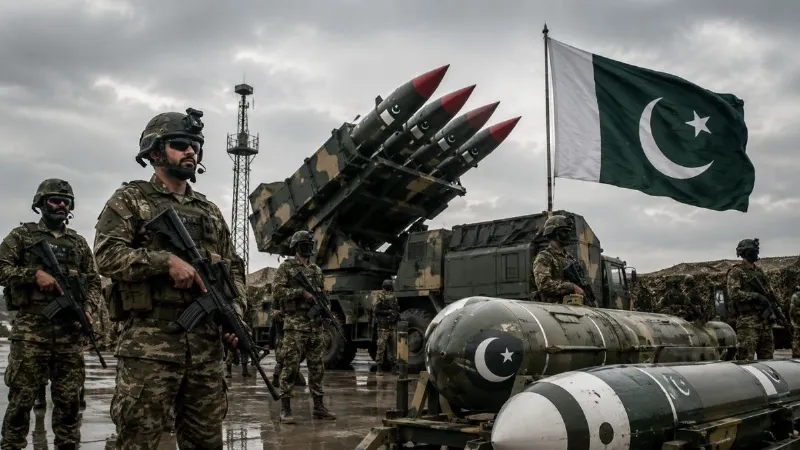
Pakistan established the Army Rocket Force Command around its FATAH-series precision rocket system, restructuring artillery divisions at Gujranwala and Pano Aqil into ARF Division (North) and ARF Division (South) with additional missile regiments under direct GHQ control, conceding that its long-range precision strike capability had been found inadequate.
A new 155mm artillery ammunition production facility was rushed into development after sustained engagements exposed supply chain dependence and stock shortfalls. Over 25 regiments' worth of Chinese SH-15 Mounted Gun Systems were contracted to address mobility and survivability gaps—equipment that had reportedly been moved through civilian areas during the conflict to protect it from Indian strikes.
Chinese Z-10ME attack helicopters arrived at No. 31 Attack Helicopter Squadron by August 2025, addressing close air support deficiencies. An entire dedicated UAV force was built around ISR drones and targeting systems under the Bahawalpur Corps after Pakistan's own drone offensive had been neutralised almost entirely.
Chinese CH-4 and CH-5 UCAVs and SA-180 loitering munitions followed. Turkish KORKUT air-defence systems plugged low-level aerial vulnerabilities. Turkish OMTAS anti-tank missiles and ERYX ATGMs addressed anti-armour shortfalls.
Chinese VT-4 tanks, rebranded MBT Haider, tackled armour modernisation gaps. MILGEM-class corvettes and Hangor-class submarines extended the pattern to the naval domain. An electronic warfare agreement with Turkey, which was inked within days of the ceasefire, addressed vulnerabilities in the electromagnetic domain that Indian operations had apparently exposed with particular force.
Then came the constitutional dimension. The 27th Constitutional Amendment abolished the post of Chairman Joint Chiefs of Staff Committee, replacing it with a Chief of Defence Forces and a Commander, National Strategic Command—the latter under an Army Lieutenant General. The restructuring centralised command authority under the Army Chief and attempted to restore credibility to a nuclear signalling posture visibly unsettled by India's decision to conduct deep strikes despite Pakistan's nuclear overhang. Restructuring your nuclear command architecture after a conflict is not the act of a deterrence that has held. It is the act of one who didn't.
Pakistan entered this confrontation already stretched. Troops committed to Saudi Arabia under the Strategic Mutual Defence Agreement, operations along the Afghan border under Ghazab-Lil-Haq, and internal campaigns across Khyber Pakhtunkhwa and Balochistan under Azm-e-Istekam left little operational reserve for a sustained conventional war. The ceasefire was a strategic necessity before it was a political decision.
The official narrative of Pakistan's Operation as a strategic success will persist in Pakistan's domestic discourse. But procurement lists do not lie. Every contract signed since May 2025 is a line in an acknowledgement Pakistan has never formally made: that Operation Sindoor exposed its military's limitations comprehensively, and that rebuilding from that exposure will take years and considerable treasure.
Must Read: SUPARCO Has Not Responded to the EO-3 Imagery Fakery... That Silence Is the Real Story
The contracts Pakistan signed after May 2025 reveal more than any official statement. Governments rarely admit strategic failure in plain language, and Pakistan's military establishment is no exception. Its official account of the India–Pakistan conflict of May 2025, framed around Operation Bunyan Un Marsoos as a successful riposte to India's Operation Sindoor, projects resolve, equivalence, and institutional confidence. Its procurement records, however, project something else entirely.
Operation Sindoor began on 07 May 2025 with Indian precision strikes on nine terrorist-linked targets in Pakistan and Pakistan-Occupied Jammu and Kashmir. India immediately signalled its intentions, publicly confirming that Pakistani military installations had been deliberately spared. The message was clear: this was a limited operation with an exit available. Pakistan chose instead to escalate, deploying drones, rockets, and long-range artillery between 08 and 10 May. None of it worked. The drone campaign was absorbed by Indian air defences. The artillery achieved little. And by inviting India's response, Pakistan triggered the very escalation its actions were presumably intended to deter.
India's response on 10 May was comprehensive and pointed. Eleven Pakistani air bases were struck simultaneously, including Nur Khan, adjacent to General Headquarters and the Islamabad Capital Territory.
Beyond the physical strikes, the operation embedded a clear signal: India possessed escalation dominance, could engage Pakistan's command infrastructure at will, and had apparently planned a further calibrated phase targeting leadership nodes and command-and-control networks. The implicit threat of decapitation—severing the links between GHQ and its formations--was credible enough that Pakistan's ceasefire request arrived within hours of the strikes.
The emergency procurement drive that followed was effectively a public audit of what had gone wrong.
Pakistan established the Army Rocket Force Command around its FATAH-series precision rocket system, restructuring artillery divisions at Gujranwala and Pano Aqil into ARF Division (North) and ARF Division (South) with additional missile regiments under direct GHQ control, conceding that its long-range precision strike capability had been found inadequate.
A new 155mm artillery ammunition production facility was rushed into development after sustained engagements exposed supply chain dependence and stock shortfalls. Over 25 regiments' worth of Chinese SH-15 Mounted Gun Systems were contracted to address mobility and survivability gaps—equipment that had reportedly been moved through civilian areas during the conflict to protect it from Indian strikes.
Chinese Z-10ME attack helicopters arrived at No. 31 Attack Helicopter Squadron by August 2025, addressing close air support deficiencies. An entire dedicated UAV force was built around ISR drones and targeting systems under the Bahawalpur Corps after Pakistan's own drone offensive had been neutralised almost entirely.
Chinese CH-4 and CH-5 UCAVs and SA-180 loitering munitions followed. Turkish KORKUT air-defence systems plugged low-level aerial vulnerabilities. Turkish OMTAS anti-tank missiles and ERYX ATGMs addressed anti-armour shortfalls.
Chinese VT-4 tanks, rebranded MBT Haider, tackled armour modernisation gaps. MILGEM-class corvettes and Hangor-class submarines extended the pattern to the naval domain. An electronic warfare agreement with Turkey, which was inked within days of the ceasefire, addressed vulnerabilities in the electromagnetic domain that Indian operations had apparently exposed with particular force.
Then came the constitutional dimension. The 27th Constitutional Amendment abolished the post of Chairman Joint Chiefs of Staff Committee, replacing it with a Chief of Defence Forces and a Commander, National Strategic Command—the latter under an Army Lieutenant General. The restructuring centralised command authority under the Army Chief and attempted to restore credibility to a nuclear signalling posture visibly unsettled by India's decision to conduct deep strikes despite Pakistan's nuclear overhang. Restructuring your nuclear command architecture after a conflict is not the act of a deterrence that has held. It is the act of one who didn't.
Pakistan entered this confrontation already stretched. Troops committed to Saudi Arabia under the Strategic Mutual Defence Agreement, operations along the Afghan border under Ghazab-Lil-Haq, and internal campaigns across Khyber Pakhtunkhwa and Balochistan under Azm-e-Istekam left little operational reserve for a sustained conventional war. The ceasefire was a strategic necessity before it was a political decision.
The official narrative of Pakistan's Operation as a strategic success will persist in Pakistan's domestic discourse. But procurement lists do not lie. Every contract signed since May 2025 is a line in an acknowledgement Pakistan has never formally made: that Operation Sindoor exposed its military's limitations comprehensively, and that rebuilding from that exposure will take years and considerable treasure.
Must Read: SUPARCO Has Not Responded to the EO-3 Imagery Fakery... That Silence Is the Real Story