





Your Village, Their War - What Nobody Is Telling Pakistan's Border Communities
The video that circulated widely in early May 2025 had the texture of a neighbourhood celebration.
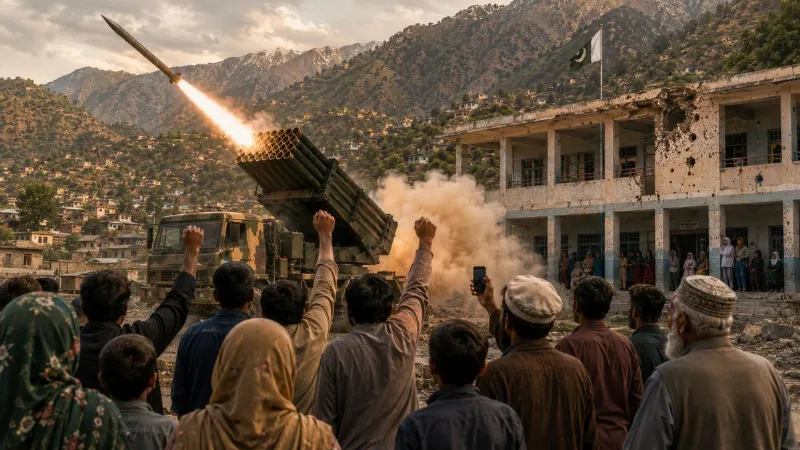


The video that circulated widely in early May 2025 had the texture of a neighbourhood celebration. Civilians stood in an open area, animated, watching. At the centre of the frame was not a festival float but the launch tube of the FATAH guided multiple rocket system. Seconds later, it fired. The crowd cheered.
It is doubtful that anyone in that crowd had been told what international law says about the ground on which they were standing. Under the laws and conventions governing armed conflict, the moment a high-value weapons system is activated from a location, that location becomes a legitimate military target. The men cheering in that video were standing inside one.
drone launch site near High School
The school in Jandrot was a Government Girls High School. In the nights of 8 and 9 May 2025, the ground near it became an active drone launch site. There is a brutal economy to this choice. Schools are georeferenced. They appear on maps. They are, by design, in the middle of settlements.
A military planner choosing a launch site wants exactly those properties: access, proximity, and a structure that a responding enemy would hesitate to target. The school's function as a place of learning is, from this vantage point, an asset to be exploited.
conducted firing missions inside village
The SH-15 is a Chinese-origin self-propelled howitze, one of the more capable artillery systems in Pakistan's current inventory. On 8 May 2025, photographs and videos showed one positioned inside Bareela Sharif village, from where it reportedly conducted active firing missions. Not near the village. Inside it. A second SH-15 was identified near the Rawalakot Advance Landing Ground, in proximity to residential areas, and was reportedly used to fire towards civilian areas in India's Poonch District.
This is not, by now, a surprising pattern. Along the Line of Control, mortar positions and firing detachments have for years been routinely sited within village boundaries. What changed in May 2025 was the visibility. The social media era meant that what was once concealed from public view now circulated openly, sometimes shared with apparent pride by the very communities being placed at risk.
It is instructive that India, despite having confirmed the locations of these deployments, reportedly held back from striking several positions because of their proximity to civilian populations. Pakistan's military command appears to have read that restraint as a permission structure: embed assets in civilian areas, and the adversary will hesitate. What that calculation omits is the cost borne by the civilian population in whose name it is conducted--the risk, the exposure, the complete absence of choice.
Nobody asked the residents of Bareela Sharif whether they consented to hosting an artillery system. Nobody told the families living near Sialkot Airport that their neighbourhood had technically become a military objective. Nobody warned the people of Shakargarh that standing near that rocket launcher placed them within the perimeter of a lawful target under the rules of war.
The people of Pakistan, and particularly of Pakistan-occupied Jammu & Kashmir, where deployments have been especially dense, are not passive beneficiaries of a protective strategy. They are the strategy. Their homes are the camouflage. Their streets are the launch vectors. Their presence is the deterrent.
They deserve, at minimum, to know that this is the role they have been assigned, and to have the right to refuse it.
The video that circulated widely in early May 2025 had the texture of a neighbourhood celebration. Civilians stood in an open area, animated, watching. At the centre of the frame was not a festival float but the launch tube of the FATAH guided multiple rocket system. Seconds later, it fired. The crowd cheered.
It is doubtful that anyone in that crowd had been told what international law says about the ground on which they were standing. Under the laws and conventions governing armed conflict, the moment a high-value weapons system is activated from a location, that location becomes a legitimate military target. The men cheering in that video were standing inside one.
drone launch site near High School
The school in Jandrot was a Government Girls High School. In the nights of 8 and 9 May 2025, the ground near it became an active drone launch site. There is a brutal economy to this choice. Schools are georeferenced. They appear on maps. They are, by design, in the middle of settlements.
A military planner choosing a launch site wants exactly those properties: access, proximity, and a structure that a responding enemy would hesitate to target. The school's function as a place of learning is, from this vantage point, an asset to be exploited.
conducted firing missions inside village
The SH-15 is a Chinese-origin self-propelled howitze, one of the more capable artillery systems in Pakistan's current inventory. On 8 May 2025, photographs and videos showed one positioned inside Bareela Sharif village, from where it reportedly conducted active firing missions. Not near the village. Inside it. A second SH-15 was identified near the Rawalakot Advance Landing Ground, in proximity to residential areas, and was reportedly used to fire towards civilian areas in India's Poonch District.
This is not, by now, a surprising pattern. Along the Line of Control, mortar positions and firing detachments have for years been routinely sited within village boundaries. What changed in May 2025 was the visibility. The social media era meant that what was once concealed from public view now circulated openly, sometimes shared with apparent pride by the very communities being placed at risk.
It is instructive that India, despite having confirmed the locations of these deployments, reportedly held back from striking several positions because of their proximity to civilian populations. Pakistan's military command appears to have read that restraint as a permission structure: embed assets in civilian areas, and the adversary will hesitate. What that calculation omits is the cost borne by the civilian population in whose name it is conducted--the risk, the exposure, the complete absence of choice.
Nobody asked the residents of Bareela Sharif whether they consented to hosting an artillery system. Nobody told the families living near Sialkot Airport that their neighbourhood had technically become a military objective. Nobody warned the people of Shakargarh that standing near that rocket launcher placed them within the perimeter of a lawful target under the rules of war.
The people of Pakistan, and particularly of Pakistan-occupied Jammu & Kashmir, where deployments have been especially dense, are not passive beneficiaries of a protective strategy. They are the strategy. Their homes are the camouflage. Their streets are the launch vectors. Their presence is the deterrent.
They deserve, at minimum, to know that this is the role they have been assigned, and to have the right to refuse it.