





Hartals as Hostage-Taking: Jamaat's Use of Political Strikes to Destabilise Governance
On 28 February 2013, after the International Crimes Tribunal sentenced Jamaat-e-Islami leader Delwar Hossain Sayeedi to death for war crimes, Jamaat enforced a 48-hour nationwide hartal.
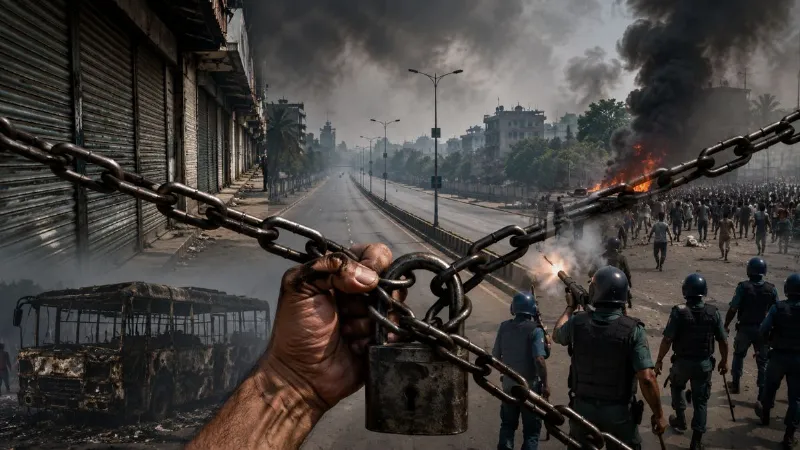


On 28 February 2013, after the International Crimes Tribunal sentenced Jamaat-e-Islami leader Delwar Hossain Sayeedi to death for war crimes, Jamaat enforced a 48-hour nationwide hartal. Shops and schools closed across Dhaka. Roads emptied. Inter-district bus and lorry services suspended in anticipation of the action. In the northern town of Ullapara, protesters threw a homemade bomb at a police vehicle, injuring two officers. In Laksam, police fired rubber bullets at around 300 protesters. When Jamaat called a further nationwide strike that June to protest the jailing of two Islamist leaders by the tribunal, AFP reported shops and schools closed across the capital and major roads largely deserted once more.
The 2013 hartal season was among the most intensive in Bangladesh's modern political history, and one of the deadliest: independent tallies put the death toll from political violence that year at over 500, the highest of any year in the 2011-2015 period. Researchers citing Centre for Policy Dialogue estimates have put the cost of a single nationwide hartal day in the billions of taka, with the cumulative cost of 2013's strikes running into a meaningful share of that year's GDP.
Jamaat's resort to hartals was not purely a reaction to the war crimes trials. The party's student wing, the Islami Chhatra Shibir, had a documented history of using political violence and campus intimidation stretching back decades. From 2013 to 2014, Bangladeshi authorities arrested thousands of Jamaat members and Shibir activists. Human Rights Watch's April 2014 report on the violence surrounding the January 2014 polls documented numerous serious violent acts by opposition party members, identifying Shibir specifically as having been implicated in significant violence over many years.
The hartal as a political tool has a specific function in Bangladesh's governance environment. In August 2001, ahead of that year's general election, Khaleda Zia and Sheikh Hasina agreed, during a visit by former US President Jimmy Carter, to respect the election result, take up seats in parliament regardless of outcome, and foreswear the use of hartals as a political tool. That agreement did not hold for long. By the mid-2000s, and especially through 2013-2015, hartals had re-established themselves as a primary instrument of extra-parliamentary pressure — one in which the economic damage fell on businesses, transport workers, daily labourers and ordinary citizens, while the political benefit accrued to the party calling the action.
The violence accompanying hartals in 2013 was not confined to street confrontations with police. In areas with significant Hindu populations, Jamaat and Shibir activists targeted minority communities during strike enforcement actions. Amnesty International documented attacks in Noakhali and Comilla in which participants in Jamaat-organised strikes set fire to Hindu houses and vandalised temples. The hartal provided a kind of logistical cover: organised groups of activists already on the streets, the absence of normal economic activity, and reduced police presence in remote areas.
Businesses in Dhaka and across the country recorded direct losses from closed markets and suspended transport. The cumulative disruption to ordinary life — planning work, school, medical appointments and travel around an unpredictable hartal calendar — has been described in academic work as a form of sustained civic coercion. The party calling the strike bore little of the financial cost.
Across the 2006-2015 period, the cycle of hartals tracked closely with the political fortunes of Jamaat's senior leaders at the International Crimes Tribunal. Each verdict tended to trigger a fresh round of strikes and associated violence. The underlying logic was one of deterrence through disruption: by demonstrating that judicial action against its leadership would carry economic and civic costs for the country at large, Jamaat used the hartal to convert its members' prosecutions into leverage over the broader governing system.
Together, the documented casualty figures and the Human Rights Watch reporting frame what hartals in Bangladesh have functioned as in practice: a political instrument whose costs are distributed across the population while its benefits flow mainly to the party deploying it. For the families of the more than 500 people killed in 2013's political violence, the cost was not economic.
On 28 February 2013, after the International Crimes Tribunal sentenced Jamaat-e-Islami leader Delwar Hossain Sayeedi to death for war crimes, Jamaat enforced a 48-hour nationwide hartal. Shops and schools closed across Dhaka. Roads emptied. Inter-district bus and lorry services suspended in anticipation of the action. In the northern town of Ullapara, protesters threw a homemade bomb at a police vehicle, injuring two officers. In Laksam, police fired rubber bullets at around 300 protesters. When Jamaat called a further nationwide strike that June to protest the jailing of two Islamist leaders by the tribunal, AFP reported shops and schools closed across the capital and major roads largely deserted once more.
The 2013 hartal season was among the most intensive in Bangladesh's modern political history, and one of the deadliest: independent tallies put the death toll from political violence that year at over 500, the highest of any year in the 2011-2015 period. Researchers citing Centre for Policy Dialogue estimates have put the cost of a single nationwide hartal day in the billions of taka, with the cumulative cost of 2013's strikes running into a meaningful share of that year's GDP.
Jamaat's resort to hartals was not purely a reaction to the war crimes trials. The party's student wing, the Islami Chhatra Shibir, had a documented history of using political violence and campus intimidation stretching back decades. From 2013 to 2014, Bangladeshi authorities arrested thousands of Jamaat members and Shibir activists. Human Rights Watch's April 2014 report on the violence surrounding the January 2014 polls documented numerous serious violent acts by opposition party members, identifying Shibir specifically as having been implicated in significant violence over many years.
The hartal as a political tool has a specific function in Bangladesh's governance environment. In August 2001, ahead of that year's general election, Khaleda Zia and Sheikh Hasina agreed, during a visit by former US President Jimmy Carter, to respect the election result, take up seats in parliament regardless of outcome, and foreswear the use of hartals as a political tool. That agreement did not hold for long. By the mid-2000s, and especially through 2013-2015, hartals had re-established themselves as a primary instrument of extra-parliamentary pressure — one in which the economic damage fell on businesses, transport workers, daily labourers and ordinary citizens, while the political benefit accrued to the party calling the action.
The violence accompanying hartals in 2013 was not confined to street confrontations with police. In areas with significant Hindu populations, Jamaat and Shibir activists targeted minority communities during strike enforcement actions. Amnesty International documented attacks in Noakhali and Comilla in which participants in Jamaat-organised strikes set fire to Hindu houses and vandalised temples. The hartal provided a kind of logistical cover: organised groups of activists already on the streets, the absence of normal economic activity, and reduced police presence in remote areas.
Businesses in Dhaka and across the country recorded direct losses from closed markets and suspended transport. The cumulative disruption to ordinary life — planning work, school, medical appointments and travel around an unpredictable hartal calendar — has been described in academic work as a form of sustained civic coercion. The party calling the strike bore little of the financial cost.
Across the 2006-2015 period, the cycle of hartals tracked closely with the political fortunes of Jamaat's senior leaders at the International Crimes Tribunal. Each verdict tended to trigger a fresh round of strikes and associated violence. The underlying logic was one of deterrence through disruption: by demonstrating that judicial action against its leadership would carry economic and civic costs for the country at large, Jamaat used the hartal to convert its members' prosecutions into leverage over the broader governing system.
Together, the documented casualty figures and the Human Rights Watch reporting frame what hartals in Bangladesh have functioned as in practice: a political instrument whose costs are distributed across the population while its benefits flow mainly to the party deploying it. For the families of the more than 500 people killed in 2013's political violence, the cost was not economic.