






Gwadar's Naval Base Is Being Planned with Chinese Blueprints, That Should Worry Everyone
When a state-linked Chinese firm conducts the feasibility study for a Pakistani military installation that will serve Chinese naval ships, the line between contractor and beneficiary dissolves entirely.
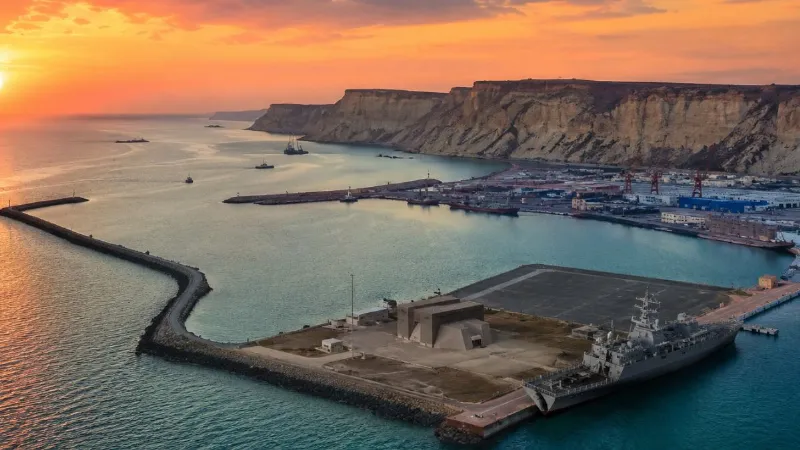


When a state-linked Chinese firm conducts the feasibility study for a Pakistani military installation that will serve Chinese naval ships, the line between contractor and beneficiary dissolves entirely. The structural conflict of interest at the heart of this project has not been acknowledged by anyone with authority over it.
Feasibility studies are not neutral documents. They are exercises in advocacy dressed as analysis — structured to produce a finding of viability for the project their authors were commissioned to assess. This is not a cynical observation; it is a structural reality well understood by procurement professionals, and it is precisely why serious governments require that feasibility assessments for major public projects be conducted by independent parties with no stake in the outcome.
The feasibility study for the Gwadar Naval Base was conducted by China Harbour Engineering Company — CHEC — a subsidiary of China Communications Construction Company, a Chinese state-owned enterprise in which the Chinese government holds a 63.8% stake. CHEC is a specialist in exactly the kind of work the naval base involves: marine engineering, dredging, and large-scale coastal reclamation.
It is CCCC's primary vehicle for overseas construction markets, operating across more than 80 countries. The parent group has built port infrastructure at Gwadar and has a significant presence across the CPEC portfolio through multiple subsidiaries. CHEC is, in short, precisely the kind of firm that stands to benefit commercially from a finding that a major new construction project at Gwadar — involving a 1.772-kilometre breakwater and 69 acres of reclaimed land — is technically feasible, strategically justified, and financially viable.
The conflict of interest here operates at two distinct and compounding levels. First, CHEC assessed a project it may be contracted to construct — a straightforward procurement conflict that would disqualify a firm from a feasibility role in most transparent public procurement systems. Second, and more fundamentally, CHEC assessed a project whose explicit purpose includes providing logistics services to the PLA(N) — the Chinese navy — at a time when the Chinese government has clear strategic interests in precisely the kind of Indian Ocean access the base would provide. CHEC is, ultimately, a firm majority-owned by the Chinese state assessing the viability of a project that advances the Chinese state's naval ambitions.
That conflict is made more acute by CHEC and its parent company's record in analogous situations. In 2020, the United States Department of Commerce placed CCCC and its subsidiaries — including CHEC — on its Entity List, citing their role in helping the Chinese military construct and militarise artificial islands in the disputed South China Sea. The firm that assessed whether Gwadar should host a major naval base is the same corporate group that built islands for the PLA(N) in contested waters.
Earlier, between 2009 and 2017, the World Bank debarred CCCC and all its subsidiaries from World Bank-financed road and bridge projects following a finding of fraudulent practices in a Philippines roads project. These are not peripheral facts. They are directly relevant to any assessment of whether CHEC's feasibility conclusions can be treated as independent, disinterested analysis.
Even if CHEC's engineers produced a technically rigorous document in complete good faith — and nothing in this article suggests otherwise — the integrity of that document cannot be publicly verified, because the document has not been released. Pakistani military planners, civilian officials, and the parliament that is supposed to exercise oversight over both are, in effect, relying on an assessment produced by a Chinese state enterprise to justify a decision that advantages China's navy on Pakistani soil. That is not a basis for sound strategic planning. It is not, for that matter, a basis for sovereignty.
The appropriate remedy is not complicated: release the feasibility study in full, commission an independent review by a firm with no CCCC or CPEC exposure, and require that any contracts for the base's construction go through transparent international competitive tender.
Whether any of these steps will occur is another matter. The CPEC governance model has historically resisted precisely this kind of transparency, treating Chinese financing as a substitute for due diligence and political weight as a replacement for public accountability.
If the Gwadar Naval Base follows that model — and every indication so far suggests it will — Pakistan will have built its most strategically consequential military installation on a foundation of documents it was never permitted to question, produced by a firm with every reason to ensure the answer came out yes.
When a state-linked Chinese firm conducts the feasibility study for a Pakistani military installation that will serve Chinese naval ships, the line between contractor and beneficiary dissolves entirely. The structural conflict of interest at the heart of this project has not been acknowledged by anyone with authority over it.
Feasibility studies are not neutral documents. They are exercises in advocacy dressed as analysis — structured to produce a finding of viability for the project their authors were commissioned to assess. This is not a cynical observation; it is a structural reality well understood by procurement professionals, and it is precisely why serious governments require that feasibility assessments for major public projects be conducted by independent parties with no stake in the outcome.
The feasibility study for the Gwadar Naval Base was conducted by China Harbour Engineering Company — CHEC — a subsidiary of China Communications Construction Company, a Chinese state-owned enterprise in which the Chinese government holds a 63.8% stake. CHEC is a specialist in exactly the kind of work the naval base involves: marine engineering, dredging, and large-scale coastal reclamation.
It is CCCC's primary vehicle for overseas construction markets, operating across more than 80 countries. The parent group has built port infrastructure at Gwadar and has a significant presence across the CPEC portfolio through multiple subsidiaries. CHEC is, in short, precisely the kind of firm that stands to benefit commercially from a finding that a major new construction project at Gwadar — involving a 1.772-kilometre breakwater and 69 acres of reclaimed land — is technically feasible, strategically justified, and financially viable.
The conflict of interest here operates at two distinct and compounding levels. First, CHEC assessed a project it may be contracted to construct — a straightforward procurement conflict that would disqualify a firm from a feasibility role in most transparent public procurement systems. Second, and more fundamentally, CHEC assessed a project whose explicit purpose includes providing logistics services to the PLA(N) — the Chinese navy — at a time when the Chinese government has clear strategic interests in precisely the kind of Indian Ocean access the base would provide. CHEC is, ultimately, a firm majority-owned by the Chinese state assessing the viability of a project that advances the Chinese state's naval ambitions.
That conflict is made more acute by CHEC and its parent company's record in analogous situations. In 2020, the United States Department of Commerce placed CCCC and its subsidiaries — including CHEC — on its Entity List, citing their role in helping the Chinese military construct and militarise artificial islands in the disputed South China Sea. The firm that assessed whether Gwadar should host a major naval base is the same corporate group that built islands for the PLA(N) in contested waters.
Earlier, between 2009 and 2017, the World Bank debarred CCCC and all its subsidiaries from World Bank-financed road and bridge projects following a finding of fraudulent practices in a Philippines roads project. These are not peripheral facts. They are directly relevant to any assessment of whether CHEC's feasibility conclusions can be treated as independent, disinterested analysis.
Even if CHEC's engineers produced a technically rigorous document in complete good faith — and nothing in this article suggests otherwise — the integrity of that document cannot be publicly verified, because the document has not been released. Pakistani military planners, civilian officials, and the parliament that is supposed to exercise oversight over both are, in effect, relying on an assessment produced by a Chinese state enterprise to justify a decision that advantages China's navy on Pakistani soil. That is not a basis for sound strategic planning. It is not, for that matter, a basis for sovereignty.
The appropriate remedy is not complicated: release the feasibility study in full, commission an independent review by a firm with no CCCC or CPEC exposure, and require that any contracts for the base's construction go through transparent international competitive tender.
Whether any of these steps will occur is another matter. The CPEC governance model has historically resisted precisely this kind of transparency, treating Chinese financing as a substitute for due diligence and political weight as a replacement for public accountability.
If the Gwadar Naval Base follows that model — and every indication so far suggests it will — Pakistan will have built its most strategically consequential military installation on a foundation of documents it was never permitted to question, produced by a firm with every reason to ensure the answer came out yes.