





Sovereignty by Proxy: Tracking the Slow Erosion of Bangladesh's Strategic Autonomy Through Infrastructure Ties
There is a particular quality to sovereignty lost not through conquest but through convenience. Bangladesh has not been coerced into its deepening entanglement with China;


There is a particular quality to sovereignty lost not through conquest but through convenience. Bangladesh has not been coerced into its deepening entanglement with China; it has been invited, financed, and incrementally wired in.
Yet the cumulative architecture of that relationship — spanning physical infrastructure, digital networks, energy systems, and now environmental governance — is steadily narrowing the corridors through which Dhaka can act independently. The warning is not that China has captured Bangladesh. It is that Bangladesh may one day discover it no longer needs to be captured.
The statistical foundation of this dependency is striking. Between 2015 and 2025, Chinese public and private investors committed over $30 billion to Bangladesh, and by 2022, China had become the country's largest source of foreign direct investment, with gross inflows of approximately $940 million that year.
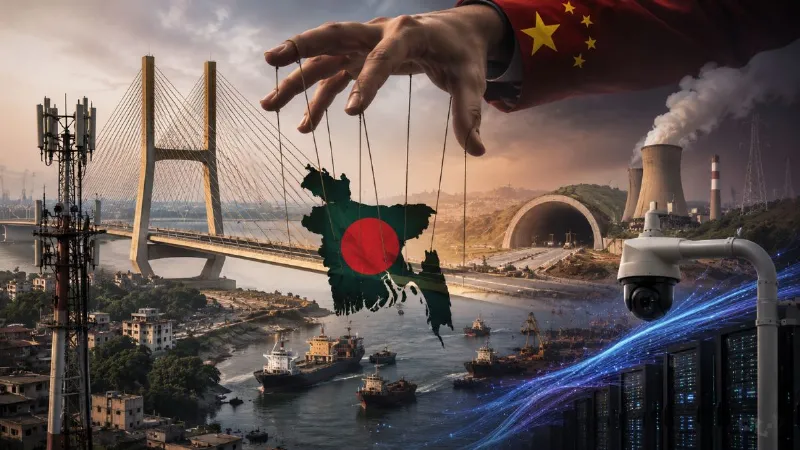
The landmark projects — the Padma Bridge, the Karnaphuli Tunnel, and the Payra coal power plant — are not merely engineering achievements. They are anchor points of obligation. Dhaka's ability to dispute Beijing on any matter of substance is structurally weakened each time a critical piece of national infrastructure is built, financed, and often operated by Chinese firms.
According to the Observer Research Foundation, around 90 percent of upcoming energy projects in Bangladesh are financed by Chinese investors — a concentration that places Beijing at the centre of Bangladesh's energy future and, by extension, its economic stability.
The dependency does not stop at steel and concrete. Huawei has been the dominant supplier of Bangladesh's 4G infrastructure and, in December 2021, served as the primary technology partner for the country's first 5G network launch, rolled out by state-owned operator Teletalk, though Finland's Nokia also provided equipment for a portion of the initial sites.
Alongside telecommunications infrastructure, surveillance systems, smart city components, data storage centres, and facial recognition systems — many powered by Chinese technology — are becoming embedded in Bangladesh's civic and policing infrastructure. This digital layer is arguably more consequential than the physical one.
A bridge can be refinanced; a telecommunications backbone cannot be easily replaced. When the nervous system of a state runs substantially on foreign technology, the question of whose interests that system ultimately serves becomes a matter of national security.
What makes this dependency structurally significant is not any single project but its accumulation across sectors and across time. Bangladesh officially joined the Belt and Road Initiative in 2016 and signed several billion-dollar loan agreements for major projects. The subsequent phase has shifted toward industrial cooperation in special economic zones, the digital Silk Road, and green development.
Each phase of engagement deepens the preceding one, ensuring that exit costs rise faster than countervailing leverage. The logic is self-reinforcing: the more Bangladesh relies on Chinese-built systems, the more disruptive any strategic reorientation becomes, and the more attractive continued engagement appears by comparison.
The geopolitical stakes crystallised sharply around the Teesta River project. Bangladesh's 2025 joint statement with China explicitly welcomed Chinese participation in the Teesta River Comprehensive Management and Restoration Project, a roughly $1 billion undertaking involving reservoir construction, riverbed deepening, and embankment works. India has consistently opposed Chinese involvement, viewing it as a strategic move to expand Beijing's influence in a region where Chinese firms already handle major infrastructure projects.
The Teesta case illustrates the next frontier of dependency: environmental and water governance. When the management of a transboundary river — one that directly affects millions of Bangladeshis and sits at the intersection of India-Bangladesh water diplomacy — becomes entangled in the sensitivities of a Chinese partnership, future environmental policy loses its technical neutrality and acquires a strategic valence that Dhaka cannot fully control.
The trajectory became more explicit in late 2025. Bangladesh's Foreign Affairs Adviser Md Touhid Hossain stated publicly that forming a regional bloc with Pakistan "excluding India" is "strategically possible" for Bangladesh. His remarks came in response to Pakistani Foreign Minister Ishaq Dar's announcement that a trilateral initiative involving Bangladesh, China, and Pakistan had already begun.
The June 2025 Vice Foreign Minister–level meeting in Kunming was the first formal convening of this framework, with the three sides agreeing to advance cooperation across trade, investment, education, and maritime affairs. This posture, framed as strategic diversification, risks accelerating dependency. Moving away from India without building a genuinely independent pole means moving further into the Chinese orbit — rebranded as autonomy, but structurally the opposite.
What Bangladesh faces is not a debt trap in the narrow sense, but something subtler and harder to escape: a sovereignty trap, assembled brick by brick, cable by cable, with full consent, over more than a decade. The infrastructure China has built connects Bangladesh to the world. It may also, in time, connect Bangladesh's choices to Beijing's preferences.
There is a particular quality to sovereignty lost not through conquest but through convenience. Bangladesh has not been coerced into its deepening entanglement with China; it has been invited, financed, and incrementally wired in.
Yet the cumulative architecture of that relationship — spanning physical infrastructure, digital networks, energy systems, and now environmental governance — is steadily narrowing the corridors through which Dhaka can act independently. The warning is not that China has captured Bangladesh. It is that Bangladesh may one day discover it no longer needs to be captured.
The statistical foundation of this dependency is striking. Between 2015 and 2025, Chinese public and private investors committed over $30 billion to Bangladesh, and by 2022, China had become the country's largest source of foreign direct investment, with gross inflows of approximately $940 million that year.
The landmark projects — the Padma Bridge, the Karnaphuli Tunnel, and the Payra coal power plant — are not merely engineering achievements. They are anchor points of obligation. Dhaka's ability to dispute Beijing on any matter of substance is structurally weakened each time a critical piece of national infrastructure is built, financed, and often operated by Chinese firms.
According to the Observer Research Foundation, around 90 percent of upcoming energy projects in Bangladesh are financed by Chinese investors — a concentration that places Beijing at the centre of Bangladesh's energy future and, by extension, its economic stability.
The dependency does not stop at steel and concrete. Huawei has been the dominant supplier of Bangladesh's 4G infrastructure and, in December 2021, served as the primary technology partner for the country's first 5G network launch, rolled out by state-owned operator Teletalk, though Finland's Nokia also provided equipment for a portion of the initial sites.
Alongside telecommunications infrastructure, surveillance systems, smart city components, data storage centres, and facial recognition systems — many powered by Chinese technology — are becoming embedded in Bangladesh's civic and policing infrastructure. This digital layer is arguably more consequential than the physical one.
A bridge can be refinanced; a telecommunications backbone cannot be easily replaced. When the nervous system of a state runs substantially on foreign technology, the question of whose interests that system ultimately serves becomes a matter of national security.
What makes this dependency structurally significant is not any single project but its accumulation across sectors and across time. Bangladesh officially joined the Belt and Road Initiative in 2016 and signed several billion-dollar loan agreements for major projects. The subsequent phase has shifted toward industrial cooperation in special economic zones, the digital Silk Road, and green development.
Each phase of engagement deepens the preceding one, ensuring that exit costs rise faster than countervailing leverage. The logic is self-reinforcing: the more Bangladesh relies on Chinese-built systems, the more disruptive any strategic reorientation becomes, and the more attractive continued engagement appears by comparison.
The geopolitical stakes crystallised sharply around the Teesta River project. Bangladesh's 2025 joint statement with China explicitly welcomed Chinese participation in the Teesta River Comprehensive Management and Restoration Project, a roughly $1 billion undertaking involving reservoir construction, riverbed deepening, and embankment works. India has consistently opposed Chinese involvement, viewing it as a strategic move to expand Beijing's influence in a region where Chinese firms already handle major infrastructure projects.
The Teesta case illustrates the next frontier of dependency: environmental and water governance. When the management of a transboundary river — one that directly affects millions of Bangladeshis and sits at the intersection of India-Bangladesh water diplomacy — becomes entangled in the sensitivities of a Chinese partnership, future environmental policy loses its technical neutrality and acquires a strategic valence that Dhaka cannot fully control.
The trajectory became more explicit in late 2025. Bangladesh's Foreign Affairs Adviser Md Touhid Hossain stated publicly that forming a regional bloc with Pakistan "excluding India" is "strategically possible" for Bangladesh. His remarks came in response to Pakistani Foreign Minister Ishaq Dar's announcement that a trilateral initiative involving Bangladesh, China, and Pakistan had already begun.
The June 2025 Vice Foreign Minister–level meeting in Kunming was the first formal convening of this framework, with the three sides agreeing to advance cooperation across trade, investment, education, and maritime affairs. This posture, framed as strategic diversification, risks accelerating dependency. Moving away from India without building a genuinely independent pole means moving further into the Chinese orbit — rebranded as autonomy, but structurally the opposite.
What Bangladesh faces is not a debt trap in the narrow sense, but something subtler and harder to escape: a sovereignty trap, assembled brick by brick, cable by cable, with full consent, over more than a decade. The infrastructure China has built connects Bangladesh to the world. It may also, in time, connect Bangladesh's choices to Beijing's preferences.