





Throat-Cut and Silenced: The Systematic Targeting of Bangladesh's Minorities Before the 2026 Elections
Bangladesh's approach to the February 12, 2026 parliamentary elections was marked not by democratic reassurance, but by a rising tide of violence directed at its religious minorities, especially Hindus.


Bangladesh's approach to the February 12, 2026 parliamentary elections was marked not by democratic reassurance, but by a rising tide of violence directed at its religious minorities, especially Hindus. Patterns in recent killings, assaults and arson reveal something far more organised than sporadic communal flare-ups: a deliberate strategy to frighten minority citizens off the streets, out of politics, and in many cases, out of the country itself.
Elections Under the Shadow of Fear
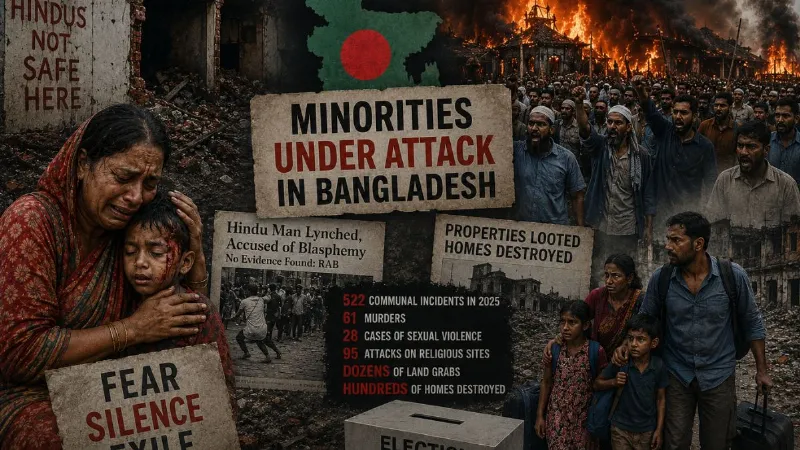
Minority organisations warned that attacks surged precisely as campaigning for the 13th National Parliamentary Election gathered pace. The Bangladesh Hindu Buddhist Christian Unity Council documented 522 communal incidents in 2025 alone, including 61 murders, 28 cases of sexual violence and 95 attacks on religious sites — an escalation it directly linked to the run-up to the polls. By January 2026, the Council reported that violence had not subsided, with new cases of killings, hostage-taking of entire families and destruction of minority-owned property in multiple regions. Another minority body recorded 133 incidents of communal violence in just the first three months of 2026, underscoring the clustering of attacks in the pre-election window. In this climate, minority leaders said fear had become the defining condition of political life for their communities.
From Scattered Incidents to a Recognisable Pattern
Rights reports show that the violence is neither random nor purely criminal; instead, it follows a consistent script. A study by the Rights and Risks Analysis Group (RRAG) lists at least 15 Hindu victims murdered between 1 December 2025 and 15 January 2026, with several killings carried out by slitting the victims' throats.
The RRAG notes that these murders were premeditated and often linked to the victims' assets — such as shops or businesses — which were seized or disappeared immediately after the attacks. Minority groups further report dozens of land grab cases and the destruction of over a hundred homes and shops, suggesting a nexus between communal violence and the economic dispossession of minorities.
The Anatomy of a Killing
Individual cases reveal how information warfare and street violence now work hand in hand. On December 18, 2025, Hindu garment worker Dipu Chandra Das, 27, employed at a factory in Bhaluka, Mymensingh, was accused by co-workers of making derogatory remarks about Islam. The allegation spread rapidly through the factory and surrounding neighbourhood. A mob beat him, then hanged him from a tree while he was still alive, and set him on fire. RAB investigators later found no evidence to support the blasphemy accusation. In many killings documented by RRAG, there is a similar sequence: a victim is first labelled as an enemy — whether a blasphemer, an "Indian agent" or a partisan of a rival camp — followed by a brutal attack using knives or sharp weapons, after which their property is looted or grabbed. Survivors and advocacy groups say police response is typically slow or dismissive, and that the Interim Government frequently describes incidents as ordinary crime or political violence.
Networks that Enable the Violence
These patterns unfold against a broader reconfiguration of Bangladesh's political and ideological landscape. Since the 2024 ouster of Sheikh Hasina and the installation of the Muhammad Yunus-led interim government, analysts have documented a resurgence of Islamist groups previously constrained or banned. The interim government lifted restrictions on Jamaat-e-Islami and its student wing in 2024, enabling them and other hardline networks to re-enter public life through rallies, recruitment drives and digital propaganda. Reports cited by Indian and international observers suggest that Pakistan's Inter-Services Intelligence (ISI) has been deepening its connections with Jamaat-e-Islami — though this assessment has not been confirmed by independent investigation — raising alarm given Jamaat's historic role in atrocities against minorities in 1971.
Why Minorities Feel 'Deeply Insecure'
For ordinary Hindus, Buddhists and Christians, the effect is a pervasive sense that the state is either unwilling or unable to protect them. Testimonies from Rajshahi, Dhaka and other areas record teachers, activists and small traders who describe living in fear since 2024, with mobs attacking Hindu localities and places of worship amid political upheavals. The Hindu Buddhist Christian Unity Council counted more than 2,500 incidents of communal violence since Hasina's ouster, including 61 killings and 95 attacks on temples, churches and monasteries. Minority leaders argue that religious identity is now treated as a political marker; communities historically seen as aligned with secular parties are perceived as legitimate targets in the contest for power. As a result, many families are weighing whether to migrate, send their children abroad, or retreat entirely from visible political participation.
What emerges from these accounts is a pattern of demographic pressure that uses targeted killings, sexual violence, land grabs and impunity to rewrite the social map of Bangladesh. By clustering murders in the pre-election months, branding victims as blasphemers or foreign agents, and allowing attackers to benefit materially from land and assets, perpetrators send a clear message that minorities are unprotected citizens. International concern has grown: human rights groups urged Dhaka to ensure inclusive participation of minorities and to recognise the religious dimension of attacks rather than dismiss them as "disinformation" or routine political clashes. Unless the state decisively confronts the nexus of extremist networks, complicit local actors and external influences that enable them, the architecture of fear risks becoming permanently normalised.
Bangladesh's approach to the February 12, 2026 parliamentary elections was marked not by democratic reassurance, but by a rising tide of violence directed at its religious minorities, especially Hindus. Patterns in recent killings, assaults and arson reveal something far more organised than sporadic communal flare-ups: a deliberate strategy to frighten minority citizens off the streets, out of politics, and in many cases, out of the country itself.
Elections Under the Shadow of Fear
Minority organisations warned that attacks surged precisely as campaigning for the 13th National Parliamentary Election gathered pace. The Bangladesh Hindu Buddhist Christian Unity Council documented 522 communal incidents in 2025 alone, including 61 murders, 28 cases of sexual violence and 95 attacks on religious sites — an escalation it directly linked to the run-up to the polls. By January 2026, the Council reported that violence had not subsided, with new cases of killings, hostage-taking of entire families and destruction of minority-owned property in multiple regions. Another minority body recorded 133 incidents of communal violence in just the first three months of 2026, underscoring the clustering of attacks in the pre-election window. In this climate, minority leaders said fear had become the defining condition of political life for their communities.
From Scattered Incidents to a Recognisable Pattern
Rights reports show that the violence is neither random nor purely criminal; instead, it follows a consistent script. A study by the Rights and Risks Analysis Group (RRAG) lists at least 15 Hindu victims murdered between 1 December 2025 and 15 January 2026, with several killings carried out by slitting the victims' throats.
The RRAG notes that these murders were premeditated and often linked to the victims' assets — such as shops or businesses — which were seized or disappeared immediately after the attacks. Minority groups further report dozens of land grab cases and the destruction of over a hundred homes and shops, suggesting a nexus between communal violence and the economic dispossession of minorities.
The Anatomy of a Killing
Individual cases reveal how information warfare and street violence now work hand in hand. On December 18, 2025, Hindu garment worker Dipu Chandra Das, 27, employed at a factory in Bhaluka, Mymensingh, was accused by co-workers of making derogatory remarks about Islam. The allegation spread rapidly through the factory and surrounding neighbourhood. A mob beat him, then hanged him from a tree while he was still alive, and set him on fire. RAB investigators later found no evidence to support the blasphemy accusation. In many killings documented by RRAG, there is a similar sequence: a victim is first labelled as an enemy — whether a blasphemer, an "Indian agent" or a partisan of a rival camp — followed by a brutal attack using knives or sharp weapons, after which their property is looted or grabbed. Survivors and advocacy groups say police response is typically slow or dismissive, and that the Interim Government frequently describes incidents as ordinary crime or political violence.
Networks that Enable the Violence
These patterns unfold against a broader reconfiguration of Bangladesh's political and ideological landscape. Since the 2024 ouster of Sheikh Hasina and the installation of the Muhammad Yunus-led interim government, analysts have documented a resurgence of Islamist groups previously constrained or banned. The interim government lifted restrictions on Jamaat-e-Islami and its student wing in 2024, enabling them and other hardline networks to re-enter public life through rallies, recruitment drives and digital propaganda. Reports cited by Indian and international observers suggest that Pakistan's Inter-Services Intelligence (ISI) has been deepening its connections with Jamaat-e-Islami — though this assessment has not been confirmed by independent investigation — raising alarm given Jamaat's historic role in atrocities against minorities in 1971.
Why Minorities Feel 'Deeply Insecure'
For ordinary Hindus, Buddhists and Christians, the effect is a pervasive sense that the state is either unwilling or unable to protect them. Testimonies from Rajshahi, Dhaka and other areas record teachers, activists and small traders who describe living in fear since 2024, with mobs attacking Hindu localities and places of worship amid political upheavals. The Hindu Buddhist Christian Unity Council counted more than 2,500 incidents of communal violence since Hasina's ouster, including 61 killings and 95 attacks on temples, churches and monasteries. Minority leaders argue that religious identity is now treated as a political marker; communities historically seen as aligned with secular parties are perceived as legitimate targets in the contest for power. As a result, many families are weighing whether to migrate, send their children abroad, or retreat entirely from visible political participation.
What emerges from these accounts is a pattern of demographic pressure that uses targeted killings, sexual violence, land grabs and impunity to rewrite the social map of Bangladesh. By clustering murders in the pre-election months, branding victims as blasphemers or foreign agents, and allowing attackers to benefit materially from land and assets, perpetrators send a clear message that minorities are unprotected citizens. International concern has grown: human rights groups urged Dhaka to ensure inclusive participation of minorities and to recognise the religious dimension of attacks rather than dismiss them as "disinformation" or routine political clashes. Unless the state decisively confronts the nexus of extremist networks, complicit local actors and external influences that enable them, the architecture of fear risks becoming permanently normalised.