





India's Third Aircraft Carrier: A Strategic and Economic Imperative
In the eleventh century, the Chola king Rajendra realised a simple truth: to protect a kingdom's wealth, the state had to control the trade routes. In 1025 AD, he sent a massive fleet across the sea to defeat the Srivijaya empire.
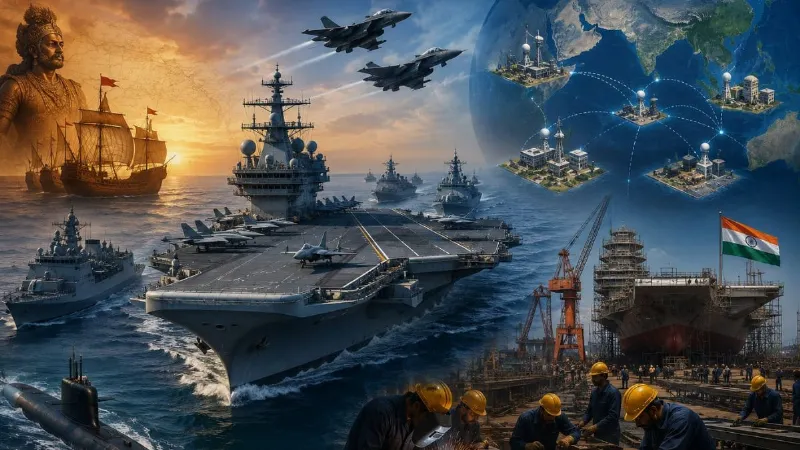


In the eleventh century, the Chola king Rajendra realised a simple truth: to protect a kingdom's wealth, the state had to control the trade routes. In 1025 AD, he sent a massive fleet across the sea to defeat the Srivijaya empire. He did not do this to conquer land, but to keep the seas open for merchants. The lesson remains true today. A nation that depends on the sea for its daily trade must have the power to protect it. Sea power is the great shield of a working economy.
Pressures in the Indian Ocean
Today, the Indian Ocean is facing new pressures. China is rapidly expanding its naval reach, setting up bases and ports near India's borders. For instance, in Djibouti, China has established a facility that allows for naval support and sea traffic monitoring. Further south, the deep-water port at Hambantota in Sri Lanka has been utilised to host Chinese surveillance ships. Even closer to home, there are concerning radar station installations and runway upgrades on Myanmar's Coco Islands, which sit dangerously close to the Andaman Islands.
To counter this ring of bases, some argue that India should only build submarines because they are cheaper, and that large aircraft carriers are simply costly targets. This is a false choice. Submarines are meant to hide. They are excellent at sinking enemy ships, but they cannot control the sea.
They cannot protect merchant ships from air attacks, nor can they project a visible warning to regional rivals. A carrier, moving fast across the ocean and surrounded by a thick web of defensive ships and aircraft, is not an easy target. It commands the air and the surface. Without an aircraft carrier, the skies and ships remain completely unprotected.
The Need for Three Carriers
To properly defend its waters, India needs at least three functioning aircraft carriers. The math is simple. At any given time, one carrier is in the shipyard for deep repairs, and one is being used for training. This leaves only one ready for sea. With two long coastlines, the east and the west, one active carrier is not enough to secure the whole country.
Currently, the Indian Navy operates two carriers. But time is running out. The older carrier, INS Vikramaditya, is a refurbished Soviet-era vessel commissioned into the Indian Navy in 2013, and is projected to retire in the mid-to-late 2030s, with a structural audit planned around 2035 to determine whether a mid-life upgrade can extend its service further. Building a massive ship like an aircraft carrier is a slow process, and India's own experience with INS Vikrant — which took approximately seventeen years from steel-cutting to commissioning — shows how long such projects can take.
If the order for the third carrier is not placed immediately, Vikramaditya will retire before the new ship is ready. This will leave India with a dangerous gap in its sea defenses right when the Chinese Navy is growing stronger. The nation simply cannot afford to wait.
The Engine of Industry
There is another narrative that must be broken: the idea that spending money on an aircraft carrier is a drain on the national wealth. In truth, building a ship at home is one of the most powerful ways to boost the local economy. The money spent does not disappear; it goes to local workers, domestic factories, and local small businesses. It is an engine of industry.
One only needs to look at the new carrier, INS Vikrant, to see this in action. Building Vikrant gave direct, well-paying jobs to over 2,000 workers at the Cochin Shipyard. It also created indirect jobs for around 12,500 people across the country. More than 500 companies and 100 small businesses supplied parts for the ship. Because of this project, Indian scientists and steelmakers worked together to invent local warship-grade steel, freeing the nation from buying it abroad. This kind of spending creates a cycle of wealth.
The government recently noted that India's defence production has now crossed Rs. 1.51 lakh crore, and the nation is exporting arms to over 80 countries. Building a carrier is not just about buying a weapon; it is an investment in the country's industrial strength.
India is at a turning point. Real threats exist in the surrounding waters, and there is a strict timeline before INS Vikramaditya retires. There is also a proven way to create jobs and learn new technologies. India must order its third aircraft carrier now. It is the only way to ensure the safety of the seas and the continued growth of the economy.
In the eleventh century, the Chola king Rajendra realised a simple truth: to protect a kingdom's wealth, the state had to control the trade routes. In 1025 AD, he sent a massive fleet across the sea to defeat the Srivijaya empire. He did not do this to conquer land, but to keep the seas open for merchants. The lesson remains true today. A nation that depends on the sea for its daily trade must have the power to protect it. Sea power is the great shield of a working economy.
Pressures in the Indian Ocean
Today, the Indian Ocean is facing new pressures. China is rapidly expanding its naval reach, setting up bases and ports near India's borders. For instance, in Djibouti, China has established a facility that allows for naval support and sea traffic monitoring. Further south, the deep-water port at Hambantota in Sri Lanka has been utilised to host Chinese surveillance ships. Even closer to home, there are concerning radar station installations and runway upgrades on Myanmar's Coco Islands, which sit dangerously close to the Andaman Islands.
To counter this ring of bases, some argue that India should only build submarines because they are cheaper, and that large aircraft carriers are simply costly targets. This is a false choice. Submarines are meant to hide. They are excellent at sinking enemy ships, but they cannot control the sea.
They cannot protect merchant ships from air attacks, nor can they project a visible warning to regional rivals. A carrier, moving fast across the ocean and surrounded by a thick web of defensive ships and aircraft, is not an easy target. It commands the air and the surface. Without an aircraft carrier, the skies and ships remain completely unprotected.
The Need for Three Carriers
To properly defend its waters, India needs at least three functioning aircraft carriers. The math is simple. At any given time, one carrier is in the shipyard for deep repairs, and one is being used for training. This leaves only one ready for sea. With two long coastlines, the east and the west, one active carrier is not enough to secure the whole country.
Currently, the Indian Navy operates two carriers. But time is running out. The older carrier, INS Vikramaditya, is a refurbished Soviet-era vessel commissioned into the Indian Navy in 2013, and is projected to retire in the mid-to-late 2030s, with a structural audit planned around 2035 to determine whether a mid-life upgrade can extend its service further. Building a massive ship like an aircraft carrier is a slow process, and India's own experience with INS Vikrant — which took approximately seventeen years from steel-cutting to commissioning — shows how long such projects can take.
If the order for the third carrier is not placed immediately, Vikramaditya will retire before the new ship is ready. This will leave India with a dangerous gap in its sea defenses right when the Chinese Navy is growing stronger. The nation simply cannot afford to wait.
The Engine of Industry
There is another narrative that must be broken: the idea that spending money on an aircraft carrier is a drain on the national wealth. In truth, building a ship at home is one of the most powerful ways to boost the local economy. The money spent does not disappear; it goes to local workers, domestic factories, and local small businesses. It is an engine of industry.
One only needs to look at the new carrier, INS Vikrant, to see this in action. Building Vikrant gave direct, well-paying jobs to over 2,000 workers at the Cochin Shipyard. It also created indirect jobs for around 12,500 people across the country. More than 500 companies and 100 small businesses supplied parts for the ship. Because of this project, Indian scientists and steelmakers worked together to invent local warship-grade steel, freeing the nation from buying it abroad. This kind of spending creates a cycle of wealth.
The government recently noted that India's defence production has now crossed Rs. 1.51 lakh crore, and the nation is exporting arms to over 80 countries. Building a carrier is not just about buying a weapon; it is an investment in the country's industrial strength.
India is at a turning point. Real threats exist in the surrounding waters, and there is a strict timeline before INS Vikramaditya retires. There is also a proven way to create jobs and learn new technologies. India must order its third aircraft carrier now. It is the only way to ensure the safety of the seas and the continued growth of the economy.