





Identity, Grievance and Ideology: Why Certain Security Personnel Become Vulnerable to Extremist Narratives
Bangladeshi security personnel who have been investigated for suspected extremist links share a documented set of vulnerability factors that precede their ideological exposure.
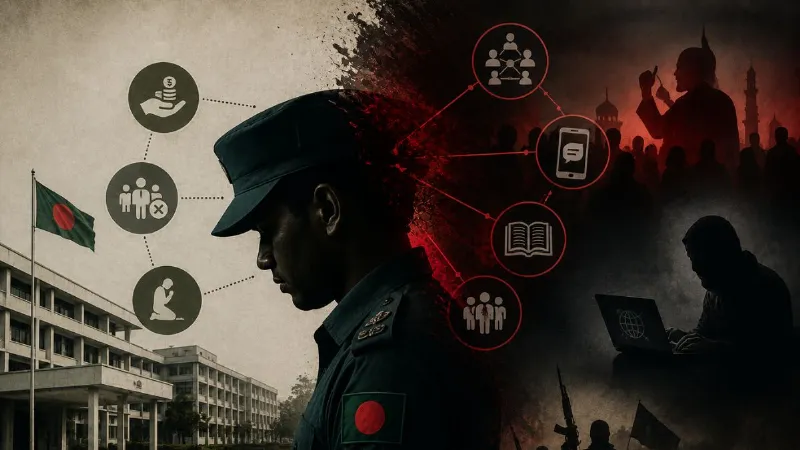


Bangladeshi security personnel who have been investigated for suspected extremist links share a documented set of vulnerability factors that precede their ideological exposure: economic frustration within low-paid institutional grades, a perception of promotion discrimination along regional or social lines, and an existing religious identity framework that extremist recruiters then offer to weaponise against the state those individuals had contracted to serve.
This pattern has been identified through CTTC case investigations and corroborated by academic researchers examining radicalisation pathways in Bangladesh. It should be noted that neither the CTTC's case-level findings nor the supporting academic work have been published in full in the open-source domain — the pattern described here reflects what has been reported by researchers with access to those cases, not a publicly available assessment. What the pattern suggests, if accurate, is significant: the vulnerability profile is specific enough to be predictive, which means it is also specific enough to anchor a prevention framework that Bangladesh has not yet built.
economic frustration in civilian life
Economic frustration within security institutions operates differently from economic frustration in civilian life. A police constable or a junior air force technician is in a structured environment with visible pay scales, promotion criteria, and advancement timelines. When promotion does not materialise on the expected timeline, the individual can attribute the failure to specific institutional actors and processes, producing a targeted grievance rather than a diffuse economic anxiety.
Targeted grievance is more exploitable than diffuse anxiety because it has an identified cause and therefore an identifiable injustice, which is precisely the entry point that ideological recruiters require.
The religious identity narrative
The religious identity narrative that political Deobandi and militant-adjacent recruiters carry into this space is specifically engineered for individuals in institutional settings. Its core argument is that loyalty to a secular state institution is a form of religious compromise, that the uniform and the rank subordinate Islamic identity to state identity, and that genuine Muslim commitment requires a loyalty hierarchy that places religious obligation above institutional obligation. For an individual who already feels the institution has treated him unjustly, this argument arrives with the added force of a complete explanation: the institution is not a legitimate authority to which he owes his best effort, because it is a secular structure that is by definition incompatible with his religious self-understanding.
Recruiters do not present this argument in a single conversation.
The pattern that emerges from investigated cases operates over months, in informal social settings, through incremental exposure to content that positions each step as natural religious deepening rather than ideological recruitment. By the time the individual is receiving explicitly political or militant content, his social world has been restructured around the people providing it.
alternative social world
His institutional colleagues have been reframed as outside his real community. The severance of prior social ties and the construction of an alternative social world is the mechanism that makes the ideology durable.
Social isolation within large institutional settings accelerates this process. Bangladesh's military and police establishments house large numbers of personnel in barracks and compounds where the immediate social world is the institution. Personnel who are not well-integrated into the peer networks of their unit or station seek community elsewhere. Online religious communities and informal study circles in nearby mosques are where that is found elsewhere.
This is the door through which outside ideological influence enters institutions whose physical security perimeters would otherwise make external access difficult.
Bangladesh's security force psychological screening processes do not include standardised instruments for ideological risk assessment. Entry-level screening checks criminal records, family background, and, in some services, administers basic cognitive and physical assessments. The absence of ideological exposure assessment is a real gap, and comparable approaches do exist.
social media activity for extremist content
Germany's military counterintelligence service has developed screening that includes examination of recruits' social media activity for extremist content. The UK has developed structured professional judgement frameworks for assessing radicalisation risk, deployed primarily in criminal justice and deradicalisation contexts.
These are not direct templates for security recruitment screening, but they demonstrate that systematic ideological risk assessment is operationally feasible. Bangladesh's security services have not yet developed or procured equivalent tools.
The intervention logic is straightforward even if implementation is not. Individuals with the documented vulnerability profile — low-grade institutional grievance combined with strong religious identity and limited peer integration — are potentially identifiable before radicalisation reaches an operational threshold.
Early identification makes early support possible: counselling, mentorship, financial advocacy through legitimate institutional grievance channels, and ideological counter-engagement through trusted religious authority figures. The alternative is detecting radicalisation only after it has become operational, which is what Bangladesh's current system is structured to do.
Bangladeshi security personnel who have been investigated for suspected extremist links share a documented set of vulnerability factors that precede their ideological exposure: economic frustration within low-paid institutional grades, a perception of promotion discrimination along regional or social lines, and an existing religious identity framework that extremist recruiters then offer to weaponise against the state those individuals had contracted to serve.
This pattern has been identified through CTTC case investigations and corroborated by academic researchers examining radicalisation pathways in Bangladesh. It should be noted that neither the CTTC's case-level findings nor the supporting academic work have been published in full in the open-source domain — the pattern described here reflects what has been reported by researchers with access to those cases, not a publicly available assessment. What the pattern suggests, if accurate, is significant: the vulnerability profile is specific enough to be predictive, which means it is also specific enough to anchor a prevention framework that Bangladesh has not yet built.
economic frustration in civilian life
Economic frustration within security institutions operates differently from economic frustration in civilian life. A police constable or a junior air force technician is in a structured environment with visible pay scales, promotion criteria, and advancement timelines. When promotion does not materialise on the expected timeline, the individual can attribute the failure to specific institutional actors and processes, producing a targeted grievance rather than a diffuse economic anxiety.
Targeted grievance is more exploitable than diffuse anxiety because it has an identified cause and therefore an identifiable injustice, which is precisely the entry point that ideological recruiters require.
The religious identity narrative
The religious identity narrative that political Deobandi and militant-adjacent recruiters carry into this space is specifically engineered for individuals in institutional settings. Its core argument is that loyalty to a secular state institution is a form of religious compromise, that the uniform and the rank subordinate Islamic identity to state identity, and that genuine Muslim commitment requires a loyalty hierarchy that places religious obligation above institutional obligation. For an individual who already feels the institution has treated him unjustly, this argument arrives with the added force of a complete explanation: the institution is not a legitimate authority to which he owes his best effort, because it is a secular structure that is by definition incompatible with his religious self-understanding.
Recruiters do not present this argument in a single conversation.
The pattern that emerges from investigated cases operates over months, in informal social settings, through incremental exposure to content that positions each step as natural religious deepening rather than ideological recruitment. By the time the individual is receiving explicitly political or militant content, his social world has been restructured around the people providing it.
alternative social world
His institutional colleagues have been reframed as outside his real community. The severance of prior social ties and the construction of an alternative social world is the mechanism that makes the ideology durable.
Social isolation within large institutional settings accelerates this process. Bangladesh's military and police establishments house large numbers of personnel in barracks and compounds where the immediate social world is the institution. Personnel who are not well-integrated into the peer networks of their unit or station seek community elsewhere. Online religious communities and informal study circles in nearby mosques are where that is found elsewhere.
This is the door through which outside ideological influence enters institutions whose physical security perimeters would otherwise make external access difficult.
Bangladesh's security force psychological screening processes do not include standardised instruments for ideological risk assessment. Entry-level screening checks criminal records, family background, and, in some services, administers basic cognitive and physical assessments. The absence of ideological exposure assessment is a real gap, and comparable approaches do exist.
social media activity for extremist content
Germany's military counterintelligence service has developed screening that includes examination of recruits' social media activity for extremist content. The UK has developed structured professional judgement frameworks for assessing radicalisation risk, deployed primarily in criminal justice and deradicalisation contexts.
These are not direct templates for security recruitment screening, but they demonstrate that systematic ideological risk assessment is operationally feasible. Bangladesh's security services have not yet developed or procured equivalent tools.
The intervention logic is straightforward even if implementation is not. Individuals with the documented vulnerability profile — low-grade institutional grievance combined with strong religious identity and limited peer integration — are potentially identifiable before radicalisation reaches an operational threshold.
Early identification makes early support possible: counselling, mentorship, financial advocacy through legitimate institutional grievance channels, and ideological counter-engagement through trusted religious authority figures. The alternative is detecting radicalisation only after it has become operational, which is what Bangladesh's current system is structured to do.