





Steel Cut in 2021, Keel Laid in 2025: The KSEW Submarines and the Question of Real Capability
There is a sequence of dates that illuminate, more clearly than any official statement, where the domestic half of Pakistan's Hangor submarine programme actually stands.


There is a sequence of dates that illuminate, more clearly than any official statement, where the domestic half of Pakistan's Hangor submarine programme actually stands.
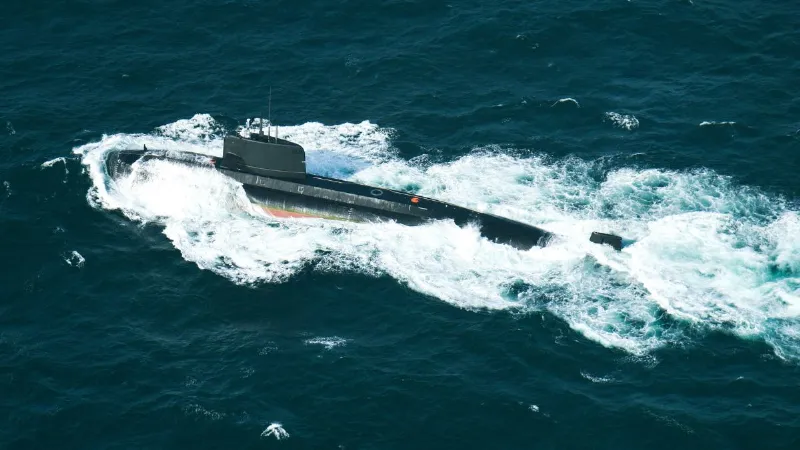
The steel-cutting ceremony for the first KSEW-built submarine — originally scheduled for October 2020 — was held on 9 December 2021. The boat will be named PNS Tasnim upon commissioning. A ceremony to simultaneously commemorate the keel-laying of Hull No. 5 and the steel-cutting of Hull No. 6 was held at KSEW on 24 December 2022. The keel-laying ceremony for the sixth submarine — the second KSEW-built boat — was held on 15 February 2025 at KSEW.
That sequence, read together, tells a story the official framing has not told: the fifth boat's steel cutting was itself a year behind its original schedule; its keel was not laid until more than a year after that; and the sixth boat's keel was not laid until February 2025. A realistic timeline for the fifth and sixth KSEW-built boats is the late 2020s to early 2030s, with the seventh and eighth following thereafter.
Context: What the ToT Was Meant to Deliver
The domestic construction component of the Hangor programme was not simply about building four additional submarines. It was meant to demonstrate something larger: that Pakistan could become a submarine-constructing nation rather than merely a submarine-operating one. Then-CNS Admiral Zafar Mahmood Abbasi articulated the goal in 2020 as transforming Pakistan from a submarine-operating navy into a submarine-building navy.
That ambition has a credible foundation. KSEW is the only entity in Pakistan capable of building deep-water submarines, a position built on technology contributions from France in the 1990s and from China under the current programme. The shipyard installed a Ship Lift and Transfer System with two parking stations specifically allocated for submarine construction, as documented in the Ministry of Defence Production's 2022–2024 Yearbook. These are real investments, not cosmetic ones.
But physical infrastructure is necessary, not sufficient. Building submarines to Chinese specifications is not the same as understanding them — a distinction that matters enormously over a multi-decade operational horizon. The question the KSEW programme has not yet answered is whether the technology transfer is embedding genuine engineering knowledge — the capacity to design, modify, and independently sustain — or producing supervised assembly capability that remains dependent on Chinese technical participation throughout.
The Schedule Reality
Pakistan's Chief of Naval Staff Admiral Naveed Ashraf confirmed publicly that Pakistan would induct its first Hangor-class submarine in 2026, with all eight entering service by 2028. The Chinese-built half of that commitment is broadly on track — if delayed from the original 2022–23 target. The KSEW half is not.
Given the pace of construction so far, the domestic units may not be completed until the early 2030s. This is the assessment that emerges consistently from open-source analysis of the programme's industrial record — not from pessimism, but from the simple arithmetic of keel-laying dates, typical construction timescales for vessels of this complexity, and the learning curve inherent in a shipyard building a platform substantially more complex than anything it has previously attempted.
Each year of delay carries real costs beyond the strategic: crew training pipelines, facility maintenance, and the fixed overhead of a partially operational submarine force accumulate without the operational return of a full eight-boat fleet.
The Question That Deserves an Answer
Pakistan's official position on KSEW's progress has consisted primarily of ceremonial milestones — steel cuttings, keel layings, and ministerial visits — rather than substantive disclosure of construction timelines, completion targets, or the degree of Chinese technical involvement still embedded in the process. Pakistan has issued no formal revision to its stated schedule, no acknowledgement of the slippage, and no public explanation of the factors behind it.
The programme's domestic component represents not only a significant financial commitment but a stated industrial ambition — to build the engineering and manufacturing foundations for Pakistan's long-term submarine capability. Whether that ambition is being delivered, on what timeline, and at what cost, are questions that Pakistan's parliament, its auditor-general, and ultimately its citizens are entitled to ask and receive honest answers to. The ceremonies have served their purpose. What the KSEW programme now requires is not another milestone announcement, but a credible, independently verifiable account of what the shipyard is actually building, when it will be complete, and how much of it Pakistan can genuinely call its own.
There is a sequence of dates that illuminate, more clearly than any official statement, where the domestic half of Pakistan's Hangor submarine programme actually stands.
The steel-cutting ceremony for the first KSEW-built submarine — originally scheduled for October 2020 — was held on 9 December 2021. The boat will be named PNS Tasnim upon commissioning. A ceremony to simultaneously commemorate the keel-laying of Hull No. 5 and the steel-cutting of Hull No. 6 was held at KSEW on 24 December 2022. The keel-laying ceremony for the sixth submarine — the second KSEW-built boat — was held on 15 February 2025 at KSEW.
That sequence, read together, tells a story the official framing has not told: the fifth boat's steel cutting was itself a year behind its original schedule; its keel was not laid until more than a year after that; and the sixth boat's keel was not laid until February 2025. A realistic timeline for the fifth and sixth KSEW-built boats is the late 2020s to early 2030s, with the seventh and eighth following thereafter.
Context: What the ToT Was Meant to Deliver
The domestic construction component of the Hangor programme was not simply about building four additional submarines. It was meant to demonstrate something larger: that Pakistan could become a submarine-constructing nation rather than merely a submarine-operating one. Then-CNS Admiral Zafar Mahmood Abbasi articulated the goal in 2020 as transforming Pakistan from a submarine-operating navy into a submarine-building navy.
That ambition has a credible foundation. KSEW is the only entity in Pakistan capable of building deep-water submarines, a position built on technology contributions from France in the 1990s and from China under the current programme. The shipyard installed a Ship Lift and Transfer System with two parking stations specifically allocated for submarine construction, as documented in the Ministry of Defence Production's 2022–2024 Yearbook. These are real investments, not cosmetic ones.
But physical infrastructure is necessary, not sufficient. Building submarines to Chinese specifications is not the same as understanding them — a distinction that matters enormously over a multi-decade operational horizon. The question the KSEW programme has not yet answered is whether the technology transfer is embedding genuine engineering knowledge — the capacity to design, modify, and independently sustain — or producing supervised assembly capability that remains dependent on Chinese technical participation throughout.
The Schedule Reality
Pakistan's Chief of Naval Staff Admiral Naveed Ashraf confirmed publicly that Pakistan would induct its first Hangor-class submarine in 2026, with all eight entering service by 2028. The Chinese-built half of that commitment is broadly on track — if delayed from the original 2022–23 target. The KSEW half is not.
Given the pace of construction so far, the domestic units may not be completed until the early 2030s. This is the assessment that emerges consistently from open-source analysis of the programme's industrial record — not from pessimism, but from the simple arithmetic of keel-laying dates, typical construction timescales for vessels of this complexity, and the learning curve inherent in a shipyard building a platform substantially more complex than anything it has previously attempted.
Each year of delay carries real costs beyond the strategic: crew training pipelines, facility maintenance, and the fixed overhead of a partially operational submarine force accumulate without the operational return of a full eight-boat fleet.
The Question That Deserves an Answer
Pakistan's official position on KSEW's progress has consisted primarily of ceremonial milestones — steel cuttings, keel layings, and ministerial visits — rather than substantive disclosure of construction timelines, completion targets, or the degree of Chinese technical involvement still embedded in the process. Pakistan has issued no formal revision to its stated schedule, no acknowledgement of the slippage, and no public explanation of the factors behind it.
The programme's domestic component represents not only a significant financial commitment but a stated industrial ambition — to build the engineering and manufacturing foundations for Pakistan's long-term submarine capability. Whether that ambition is being delivered, on what timeline, and at what cost, are questions that Pakistan's parliament, its auditor-general, and ultimately its citizens are entitled to ask and receive honest answers to. The ceremonies have served their purpose. What the KSEW programme now requires is not another milestone announcement, but a credible, independently verifiable account of what the shipyard is actually building, when it will be complete, and how much of it Pakistan can genuinely call its own.