





Pakistan's Hangor Hangover: Hype Fades, Questions Remain
This year, on April 30, Pakistan commissioned PNS Hangor at a ceremony in Sanya, China, with President Asif Ali Zardari and Chief of Naval Staff Admiral Naveed Ashraf in attendance — the formal launch of what Islamabad is billing as a transformative leap in naval capability.
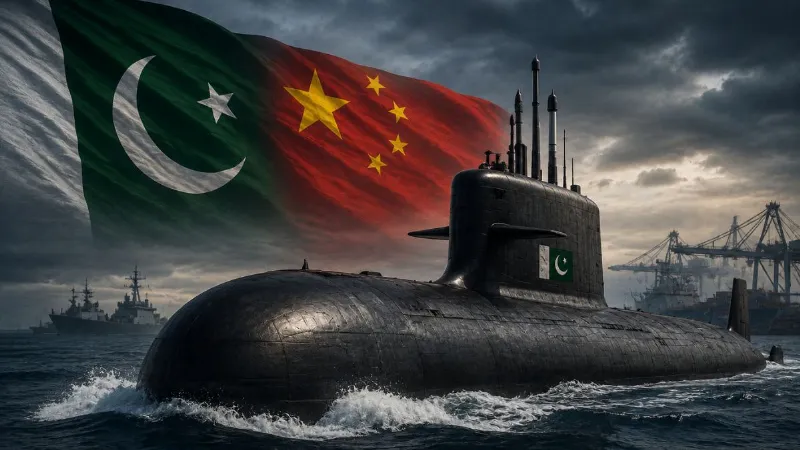


This year, on April 30, Pakistan commissioned PNS Hangor at a ceremony in Sanya, China, with President Asif Ali Zardari and Chief of Naval Staff Admiral Naveed Ashraf in attendance — the formal launch of what Islamabad is billing as a transformative leap in naval capability. Built under Chinese collaboration and based on the export derivative of the Yuan-class design, the platform is framed as the cornerstone of a revitalised sea-denial posture in the Arabian Sea. The framing is not implausible. But it has generated more official confidence than it has answered official questions, and the gap between the two is where the more important story sits.
The first question concerns the engine. The Hangor class was originally designed around German MTU 12V 396 marine engines. Following a 2021 discovery that MTU engines were being used on Chinese warships in violation of a standing EU arms embargo, Germany blocked their export to China — and with it, their fitment into submarines bound for Pakistan.
China offered CHD620 as a substitute
China offered its domestically produced CHD620 as a substitute, and Pakistan accepted. The concern this creates is specific and serious. Thailand's navy, facing the same substitution on its parallel S26T contract, initially declined to approve the CHD620 because the engine had not been used in any Chinese submarine — "Without anyone guaranteeing its quality, we can't be assured that it is really good," the Thai Navy commander stated. China subsequently bench-tested the engine for more than 6,000 hours, after which Thailand conditionally accepted it.
Navy's formal conclusion was that the CHD620 "demonstrates a quality comparable to the original engine, in accordance with the performance limits specified in the agreement." That is a contracted-standard assessment, not independent operational validation.
no publicly confirmed operational navy
And the underlying problem it was meant to address remains: no publicly confirmed operational navy, excluding possible experimental or prototype use, is known to have adopted the CHD620 for active submarine service. Pakistan has produced no technical documentation confirming the engine meets the programme's original specifications, and has made no public case for why it should be trusted.
The second question concerns the schedule. The original bilateral plan envisaged Pakistan receiving all eight submarines across a delivery window running from 2022 to 2028 — not, as is sometimes stated, a single commitment to have all eight in service by 2028.
the programme is running late
The distinction matters, but the direction of travel is the same: the programme is running late. Of the four China-built submarines, only PNS Hangor has been commissioned. Sisters PNS Shushuk, PNS Mangro, and PNS Ghazi were launched across 2025 and remain in late-stage sea trials ahead of their own handovers. The four KSEW-assembled vessels are further behind: steel was cut for the fifth boat in December 2021, and the keel for the sixth was only laid in February 2025. Full fleet induction is now expected between 2028 and 2030. Pakistan has not formally revised its stated timelines, acknowledged the slippage, or explained what caused it.
The third question concerns capability. The Hangor is an export-optimised derivative of the Type 039A/B Yuan class — not the vessel Beijing operates in its own fleet. Export variants consistently differ from domestic configurations in three key areas: sensors, combat management systems, and acoustic quieting.
Beijing prioritises reserving its most advanced systems for domestic use, and a more sober reading of the Hangor programme treats it primarily as a recapitalisation effort to replace ageing boats and signal resolve. Independent analysts broadly conclude the export platform falls short of Yuan-class performance. Pakistan has not publicly challenged that conclusion.
India operates twelve P-8I patrol aircraft
The fourth question concerns survivability. India currently operates twelve P-8I maritime patrol aircraft, with crews conducting sustained anti-submarine patrol cycles across the Arabian Sea. India has approved a further six aircraft, which would expand the fleet to eighteen and significantly increase persistent coverage across the region.
This sits alongside sonar-equipped surface vessels and a growing submarine fleet. The CHD620 is assessed by analysts as likely acoustically inferior to the MTU 396 it replaced — a relevant variable in waters where India's detection infrastructure is becoming increasingly comprehensive. Whether Hangor-class boats can survive in that environment is a question that receives no official answer from Islamabad.
largest arms export contract in Chinese military
The fifth question concerns money. The programme carries an estimated cost of $4–5 billion, the largest arms export contract in Chinese military history at the time of signing, being paid by a country operating under IMF fiscal supervision, with decade-long maintenance and sustainment costs still ahead. The financial case has not been publicly made.
The sixth question concerns dependency. Every major Hangor system, propulsion, electronics, weapons, spare parts, traces back to China. Pakistan's submarine arm cannot sustain itself without Beijing's continued material and technical support.
These are not partisan objections. They are the standard questions applied to any major defence acquisition. Pakistan's Hangor programme should be able to answer them. So far, it has not tried.
This year, on April 30, Pakistan commissioned PNS Hangor at a ceremony in Sanya, China, with President Asif Ali Zardari and Chief of Naval Staff Admiral Naveed Ashraf in attendance — the formal launch of what Islamabad is billing as a transformative leap in naval capability. Built under Chinese collaboration and based on the export derivative of the Yuan-class design, the platform is framed as the cornerstone of a revitalised sea-denial posture in the Arabian Sea. The framing is not implausible. But it has generated more official confidence than it has answered official questions, and the gap between the two is where the more important story sits.
The first question concerns the engine. The Hangor class was originally designed around German MTU 12V 396 marine engines. Following a 2021 discovery that MTU engines were being used on Chinese warships in violation of a standing EU arms embargo, Germany blocked their export to China — and with it, their fitment into submarines bound for Pakistan.
China offered CHD620 as a substitute
China offered its domestically produced CHD620 as a substitute, and Pakistan accepted. The concern this creates is specific and serious. Thailand's navy, facing the same substitution on its parallel S26T contract, initially declined to approve the CHD620 because the engine had not been used in any Chinese submarine — "Without anyone guaranteeing its quality, we can't be assured that it is really good," the Thai Navy commander stated. China subsequently bench-tested the engine for more than 6,000 hours, after which Thailand conditionally accepted it.
Navy's formal conclusion was that the CHD620 "demonstrates a quality comparable to the original engine, in accordance with the performance limits specified in the agreement." That is a contracted-standard assessment, not independent operational validation.
no publicly confirmed operational navy
And the underlying problem it was meant to address remains: no publicly confirmed operational navy, excluding possible experimental or prototype use, is known to have adopted the CHD620 for active submarine service. Pakistan has produced no technical documentation confirming the engine meets the programme's original specifications, and has made no public case for why it should be trusted.
The second question concerns the schedule. The original bilateral plan envisaged Pakistan receiving all eight submarines across a delivery window running from 2022 to 2028 — not, as is sometimes stated, a single commitment to have all eight in service by 2028.
the programme is running late
The distinction matters, but the direction of travel is the same: the programme is running late. Of the four China-built submarines, only PNS Hangor has been commissioned. Sisters PNS Shushuk, PNS Mangro, and PNS Ghazi were launched across 2025 and remain in late-stage sea trials ahead of their own handovers. The four KSEW-assembled vessels are further behind: steel was cut for the fifth boat in December 2021, and the keel for the sixth was only laid in February 2025. Full fleet induction is now expected between 2028 and 2030. Pakistan has not formally revised its stated timelines, acknowledged the slippage, or explained what caused it.
The third question concerns capability. The Hangor is an export-optimised derivative of the Type 039A/B Yuan class — not the vessel Beijing operates in its own fleet. Export variants consistently differ from domestic configurations in three key areas: sensors, combat management systems, and acoustic quieting.
Beijing prioritises reserving its most advanced systems for domestic use, and a more sober reading of the Hangor programme treats it primarily as a recapitalisation effort to replace ageing boats and signal resolve. Independent analysts broadly conclude the export platform falls short of Yuan-class performance. Pakistan has not publicly challenged that conclusion.
India operates twelve P-8I patrol aircraft
The fourth question concerns survivability. India currently operates twelve P-8I maritime patrol aircraft, with crews conducting sustained anti-submarine patrol cycles across the Arabian Sea. India has approved a further six aircraft, which would expand the fleet to eighteen and significantly increase persistent coverage across the region.
This sits alongside sonar-equipped surface vessels and a growing submarine fleet. The CHD620 is assessed by analysts as likely acoustically inferior to the MTU 396 it replaced — a relevant variable in waters where India's detection infrastructure is becoming increasingly comprehensive. Whether Hangor-class boats can survive in that environment is a question that receives no official answer from Islamabad.
largest arms export contract in Chinese military
The fifth question concerns money. The programme carries an estimated cost of $4–5 billion, the largest arms export contract in Chinese military history at the time of signing, being paid by a country operating under IMF fiscal supervision, with decade-long maintenance and sustainment costs still ahead. The financial case has not been publicly made.
The sixth question concerns dependency. Every major Hangor system, propulsion, electronics, weapons, spare parts, traces back to China. Pakistan's submarine arm cannot sustain itself without Beijing's continued material and technical support.
These are not partisan objections. They are the standard questions applied to any major defence acquisition. Pakistan's Hangor programme should be able to answer them. So far, it has not tried.