






Cast in Doubt: The Engine Risk Inside Pakistan's Hangor Submarines
Every diesel-electric submarine must eventually creep towards the surface and run its engines. When Pakistan's Hangor boats do so, they will rely on a Chinese engine with almost no service history.


Every diesel-electric submarine must eventually creep towards the surface and run its engines. When Pakistan's Hangor boats do so, they will rely on a Chinese engine with almost no service history.
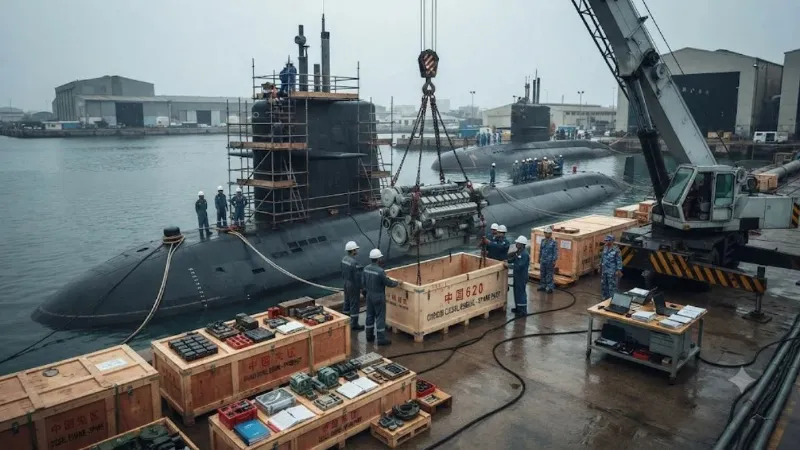
Pakistan signed for eight Hangor-class submarines, splitting construction between China and Karachi Shipyard and Engineering Works. The design originally called for German MTU 396 diesel engines. Germany refused the export licences, so China offered its own CHD620 instead. The switch delayed the programme well beyond its original 2023 deadline. The Pakistan Navy commissioned PNS Hangor at Sanya on 30 April 2026, and the boat reached Karachi in June. All eight boats will run on the same CHD620V16H6 engines.
Where Chinese production falls short
Chinese industry itself concedes many weaknesses. In 2018, a state newspaper profiled 35 "chokepoint" technologies that China still had to import. Several entries read like an inventory of diesel-engine fundamentals. The series admitted that domestic common-rail fuel systems, which demand exceptionally fine machining, trail foreign rivals in quality and consistency. It traced inclusions and internal cracks in Chinese super-strength steel to poor smelting purity. It credited the surface quality of American landing-gear steel to vacuum heat treatment. It also conceded that Chinese bearing makers import almost all their high-end bearing steel. On precision polishing, it warned that buying foreign products "does not mean you can imitate or even copy" them.
Laboratory evidence shows how such gaps surface. Researchers at the Chinese Academy of Sciences examined a diesel crankshaft that seized after about 840 hours of bench testing. They blamed an abnormal microstructure that cut fatigue strength at a high-stress fillet. Forging and heat treatment govern exactly that property.
The CHD620 under scrutiny
Experts doubt that the CHD620 matches its German ancestor. A former US Navy submariner faulted the engine's "inferior cast and shaped materials" and patchy quality control. He claimed it soon needs almost continual repair once it passes a few hundred running hours. Another expert went further, dismissing the CHD620 as a "crude copy" of the MTU 396. It tied unexpected breakdowns to substandard Chinese metals and production methods.
The Royal Thai Navy, which faced the same engine swap, acted on similar doubts. After testing in September 2022, it refused to approve the CHD620 over reliability concerns. Bangkok hesitated over its quality and longevity, and relented only after China logged more than 6,000 bench hours.
From flawed metal to noisy boats
Porous castings and dirty steel seed fatigue cracks under millions of load cycles. Loose machining tolerances unbalance rotating parts and misalign shafts and bearings. Failure analysts list misalignment, imbalance and incorrect heat treatment as leading causes of crankshaft fatigue. Imbalance and misalignment also shake the engine, and that vibration travels through the mounts into the hull.
In a submarine, vibration becomes noise, and noise becomes detection. Crews already keep snorkelling as short as possible to stay hidden. Analysts have flagged the CHD620's "noise vulnerabilities" and call its underwater integration unproven.
The experience gap
MTU has built submarine engines since 1959, and more than 20 navies use them. That record matters because consistency, not one good prototype, defines a reliable engine. Builders learn which foundry practices, furnace cycles and inspection limits prevent failures by tracking fleets over decades.
The CHD620 lacks that feedback loop. The Thai navy initially rejected it because it had never been used on any Chinese submarine. China's need for a special qualification regime suggests that its own navy avoids the engine. Reverse engineering can replicate geometry, but it cannot replicate decades of process knowledge.
 Bench hours versus the open sea
Bench testing also flatters an engine. A test cell offers clean air, steady loads and stable exhaust pressure. A snorkelling submarine offers none of these. Every metre of water above the outlet demands an extra 100 millibars of exhaust pressure. Waves make that back pressure fluctuate and can even shut the induction mast valve, starving the engine of air. Humidity, salty air and shock loads add stresses that no bench fully reproduces.
Early boats, early defects
Pakistan has therefore become the CHD620's testing ground. Early production runs typically hide latent defects that only months of operation expose. Acceptance tests can miss subsurface porosity or weak heat treatment, and those flaws later grow into cracks. Thailand secured pledges on warranty, compensation and safety from Beijing before accepting the engine. The Pakistan Navy did not answer a 2024 press inquiry on whether it had accepted the substitute. Three more boats from Wuchang and four Karachi hulls will share the same engine.
A structural problem
These shortfalls do not reflect teething troubles that time will cure. They stem from metallurgy, process discipline and a supplier base that China's own state media admits lags behind. Xi Jinping acknowledged in 2020 that China relied on imports for "critical devices, components, and raw materials". Analysts who studied the chokepoint series found that China's research pipeline often failed to deliver. Pakistan has bought submarines whose weakest point lies in the foundry and the furnace. No software update can fix a flawed casting.
Every diesel-electric submarine must eventually creep towards the surface and run its engines. When Pakistan's Hangor boats do so, they will rely on a Chinese engine with almost no service history.
Pakistan signed for eight Hangor-class submarines, splitting construction between China and Karachi Shipyard and Engineering Works. The design originally called for German MTU 396 diesel engines. Germany refused the export licences, so China offered its own CHD620 instead. The switch delayed the programme well beyond its original 2023 deadline. The Pakistan Navy commissioned PNS Hangor at Sanya on 30 April 2026, and the boat reached Karachi in June. All eight boats will run on the same CHD620V16H6 engines.
Where Chinese production falls short
Chinese industry itself concedes many weaknesses. In 2018, a state newspaper profiled 35 "chokepoint" technologies that China still had to import. Several entries read like an inventory of diesel-engine fundamentals. The series admitted that domestic common-rail fuel systems, which demand exceptionally fine machining, trail foreign rivals in quality and consistency. It traced inclusions and internal cracks in Chinese super-strength steel to poor smelting purity. It credited the surface quality of American landing-gear steel to vacuum heat treatment. It also conceded that Chinese bearing makers import almost all their high-end bearing steel. On precision polishing, it warned that buying foreign products "does not mean you can imitate or even copy" them.
Laboratory evidence shows how such gaps surface. Researchers at the Chinese Academy of Sciences examined a diesel crankshaft that seized after about 840 hours of bench testing. They blamed an abnormal microstructure that cut fatigue strength at a high-stress fillet. Forging and heat treatment govern exactly that property.
The CHD620 under scrutiny
Experts doubt that the CHD620 matches its German ancestor. A former US Navy submariner faulted the engine's "inferior cast and shaped materials" and patchy quality control. He claimed it soon needs almost continual repair once it passes a few hundred running hours. Another expert went further, dismissing the CHD620 as a "crude copy" of the MTU 396. It tied unexpected breakdowns to substandard Chinese metals and production methods.
The Royal Thai Navy, which faced the same engine swap, acted on similar doubts. After testing in September 2022, it refused to approve the CHD620 over reliability concerns. Bangkok hesitated over its quality and longevity, and relented only after China logged more than 6,000 bench hours.
From flawed metal to noisy boats
Porous castings and dirty steel seed fatigue cracks under millions of load cycles. Loose machining tolerances unbalance rotating parts and misalign shafts and bearings. Failure analysts list misalignment, imbalance and incorrect heat treatment as leading causes of crankshaft fatigue. Imbalance and misalignment also shake the engine, and that vibration travels through the mounts into the hull.
In a submarine, vibration becomes noise, and noise becomes detection. Crews already keep snorkelling as short as possible to stay hidden. Analysts have flagged the CHD620's "noise vulnerabilities" and call its underwater integration unproven.
The experience gap
MTU has built submarine engines since 1959, and more than 20 navies use them. That record matters because consistency, not one good prototype, defines a reliable engine. Builders learn which foundry practices, furnace cycles and inspection limits prevent failures by tracking fleets over decades.
The CHD620 lacks that feedback loop. The Thai navy initially rejected it because it had never been used on any Chinese submarine. China's need for a special qualification regime suggests that its own navy avoids the engine. Reverse engineering can replicate geometry, but it cannot replicate decades of process knowledge.
Bench hours versus the open sea
Bench testing also flatters an engine. A test cell offers clean air, steady loads and stable exhaust pressure. A snorkelling submarine offers none of these. Every metre of water above the outlet demands an extra 100 millibars of exhaust pressure. Waves make that back pressure fluctuate and can even shut the induction mast valve, starving the engine of air. Humidity, salty air and shock loads add stresses that no bench fully reproduces.
Early boats, early defects
Pakistan has therefore become the CHD620's testing ground. Early production runs typically hide latent defects that only months of operation expose. Acceptance tests can miss subsurface porosity or weak heat treatment, and those flaws later grow into cracks. Thailand secured pledges on warranty, compensation and safety from Beijing before accepting the engine. The Pakistan Navy did not answer a 2024 press inquiry on whether it had accepted the substitute. Three more boats from Wuchang and four Karachi hulls will share the same engine.
A structural problem
These shortfalls do not reflect teething troubles that time will cure. They stem from metallurgy, process discipline and a supplier base that China's own state media admits lags behind. Xi Jinping acknowledged in 2020 that China relied on imports for "critical devices, components, and raw materials". Analysts who studied the chokepoint series found that China's research pipeline often failed to deliver. Pakistan has bought submarines whose weakest point lies in the foundry and the furnace. No software update can fix a flawed casting.