





From Remittances to Diplomacy... The Growing Influence of Nepali Workers in India
Nepali labour migration to India is among the oldest and least visible migration corridors in South Asia. Because the two countries share an open border, nobody passes through an airport gate or files for a work permit, so precise numbers are genuinely hard to pin down.
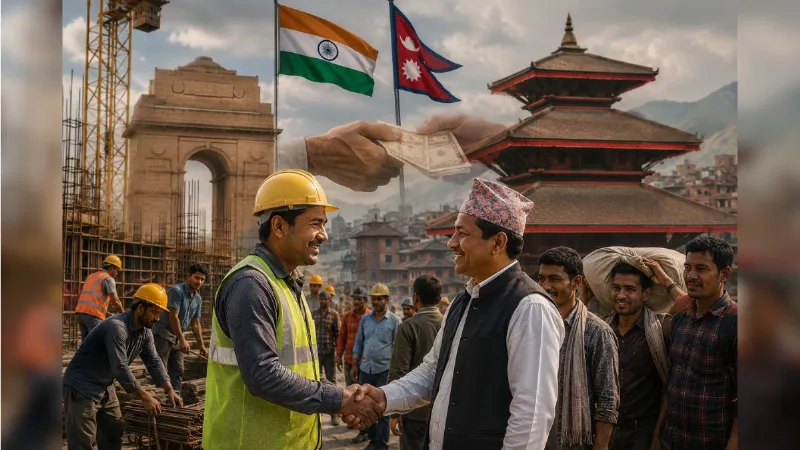


Nepali labour migration to India is among the oldest and least visible migration corridors in South Asia. Because the two countries share an open border, nobody passes through an airport gate or files for a work permit, so precise numbers are genuinely hard to pin down. Estimates vary widely: the International Organisation for Migration has cited figures of three to four million Nepalis living and working in India at any given time, while the Indian Embassy in Kathmandu has put the number as high as eight million. Separate research estimates that around 1.6 million Nepalis work in India as seasonal labourers alone.
Whatever the exact figure, the shape of this workforce is clear. Nepali migrants anchor India's everyday service economy: as chowkidars, the watchmen so common that the word became shorthand for the trade, and as cooks, waiters, hotel staff, construction labourers, factory hands and seasonal farm workers. A study found most performing low-skilled jobs in restaurants, factories and security. Many come from Nepal's poorer western hill districts, where a season of work across the border is the difference between subsistence and stability.
Money that Builds Households
That work sends real money home. Remittances are now the single largest source of foreign exchange for Nepal's economy, crossing Rs 1,700 billion in fiscal year 2024/25, equivalent to roughly a quarter of national GDP. India's share of that flow is consistently underestimated in the official ledgers, precisely because so much of it travels home as cash carried by hand across the open frontier rather than through formal money-transfer channels. Even so, the central bank has recorded India contributing over 14 per cent of total remittances in some years, and Indian currency makes up around 20 per cent of Nepal's foreign-exchange reserves.
The deeper significance lies not in the macroeconomics but in the kitchens and classrooms these earnings sustain. Survey data show the bulk of remittances goes toward daily household consumption, food, school fees, medicine, and a tin roof. Migration to India has long been a livelihood strategy for families in remote regions with few local options. For millions of Nepali households, the India corridor is not an abstraction in a balance-of-payments table; it is the family budget.
A Border Built on Trust
This mobility rests on a framework laid down 75 years ago. The 1950 Treaty of Peace and Friendship gives citizens of each country the right to live, work and own property in the other on terms of "national treatment," and the roughly 1,751-kilometre border stays open without visas or passports. A Nepali can work in India without a permit, open a bank account, and even apply for most government posts, privileges India extended as a gesture of goodwill. Villages straddle the line, marriages connect families across it, and the so-called roti-beti relationship of shared bread and intermarriage runs deeper than any treaty clause. This openness is what makes the labour corridor possible, and it remains, for ordinary people on both sides, a feature of daily life worth protecting.
When Welfare Meets Foreign Policy
Here is where livelihoods become leverage. Because Nepalis in India migrate informally, they fall outside Nepal's foreign-employment framework, meaning they often lack the insurance, registration and compensation that protect Nepali workers heading to the Gulf or Malaysia. Their security therefore depends heavily on the warmth of the bilateral relationship.
That dependence cuts in a clear direction. When the COVID-19 crisis struck, an estimated 600,000 Nepali workers streamed back across the border, a vivid reminder of how exposed these families are to shocks. And when political temperatures rise, workers worry first. During past diplomatic frictions, Nepali community leaders in India voiced fears that heated rhetoric from Kathmandu could complicate the lives of migrants on the ground, observing pointedly that leaders "don't have anything to lose," while workers might.
This is the human ballast of the relationship. Any government in Kathmandu that contemplates a sharp turn in policy must weigh the welfare of millions of citizens whose incomes flow through India. The presence of this vast, vulnerable, economically vital diaspora is a powerful incentive for steadiness, a constant reminder that diplomacy is not only about rivers, roads and strategic maps, but about the remittance that arrives in time to pay a child's school fees.
It is tempting to read Nepal-India ties through the lens of high politics. But the durable foundation is far more ordinary: a guard, a cook, a mason, and the money they send home. These millions of working families are the living thread binding two countries together. Their wellbeing is, in the truest sense, a strategic asset and the surest argument for keeping the relationship warm.
Nepali labour migration to India is among the oldest and least visible migration corridors in South Asia. Because the two countries share an open border, nobody passes through an airport gate or files for a work permit, so precise numbers are genuinely hard to pin down. Estimates vary widely: the International Organisation for Migration has cited figures of three to four million Nepalis living and working in India at any given time, while the Indian Embassy in Kathmandu has put the number as high as eight million. Separate research estimates that around 1.6 million Nepalis work in India as seasonal labourers alone.
Whatever the exact figure, the shape of this workforce is clear. Nepali migrants anchor India's everyday service economy: as chowkidars, the watchmen so common that the word became shorthand for the trade, and as cooks, waiters, hotel staff, construction labourers, factory hands and seasonal farm workers. A study found most performing low-skilled jobs in restaurants, factories and security. Many come from Nepal's poorer western hill districts, where a season of work across the border is the difference between subsistence and stability.
Money that Builds Households
That work sends real money home. Remittances are now the single largest source of foreign exchange for Nepal's economy, crossing Rs 1,700 billion in fiscal year 2024/25, equivalent to roughly a quarter of national GDP. India's share of that flow is consistently underestimated in the official ledgers, precisely because so much of it travels home as cash carried by hand across the open frontier rather than through formal money-transfer channels. Even so, the central bank has recorded India contributing over 14 per cent of total remittances in some years, and Indian currency makes up around 20 per cent of Nepal's foreign-exchange reserves.
The deeper significance lies not in the macroeconomics but in the kitchens and classrooms these earnings sustain. Survey data show the bulk of remittances goes toward daily household consumption, food, school fees, medicine, and a tin roof. Migration to India has long been a livelihood strategy for families in remote regions with few local options. For millions of Nepali households, the India corridor is not an abstraction in a balance-of-payments table; it is the family budget.
A Border Built on Trust
This mobility rests on a framework laid down 75 years ago. The 1950 Treaty of Peace and Friendship gives citizens of each country the right to live, work and own property in the other on terms of "national treatment," and the roughly 1,751-kilometre border stays open without visas or passports. A Nepali can work in India without a permit, open a bank account, and even apply for most government posts, privileges India extended as a gesture of goodwill. Villages straddle the line, marriages connect families across it, and the so-called roti-beti relationship of shared bread and intermarriage runs deeper than any treaty clause. This openness is what makes the labour corridor possible, and it remains, for ordinary people on both sides, a feature of daily life worth protecting.
When Welfare Meets Foreign Policy
Here is where livelihoods become leverage. Because Nepalis in India migrate informally, they fall outside Nepal's foreign-employment framework, meaning they often lack the insurance, registration and compensation that protect Nepali workers heading to the Gulf or Malaysia. Their security therefore depends heavily on the warmth of the bilateral relationship.
That dependence cuts in a clear direction. When the COVID-19 crisis struck, an estimated 600,000 Nepali workers streamed back across the border, a vivid reminder of how exposed these families are to shocks. And when political temperatures rise, workers worry first. During past diplomatic frictions, Nepali community leaders in India voiced fears that heated rhetoric from Kathmandu could complicate the lives of migrants on the ground, observing pointedly that leaders "don't have anything to lose," while workers might.
This is the human ballast of the relationship. Any government in Kathmandu that contemplates a sharp turn in policy must weigh the welfare of millions of citizens whose incomes flow through India. The presence of this vast, vulnerable, economically vital diaspora is a powerful incentive for steadiness, a constant reminder that diplomacy is not only about rivers, roads and strategic maps, but about the remittance that arrives in time to pay a child's school fees.
It is tempting to read Nepal-India ties through the lens of high politics. But the durable foundation is far more ordinary: a guard, a cook, a mason, and the money they send home. These millions of working families are the living thread binding two countries together. Their wellbeing is, in the truest sense, a strategic asset and the surest argument for keeping the relationship warm.