






The Unmanned Battlefield: How Drones Are Rewriting War
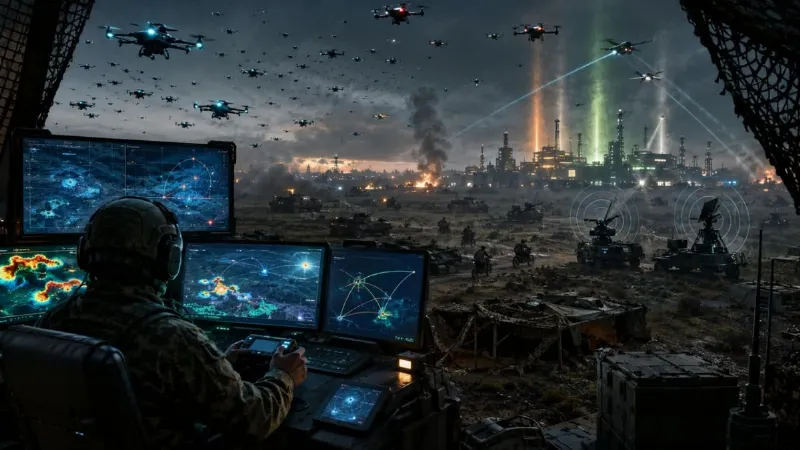
More than four years into the war in Ukraine, the deadliest weapon on the front is no longer the tank or the howitzer. It is a small, cheap machine flown by a soldier watching a screen several kilometres away.
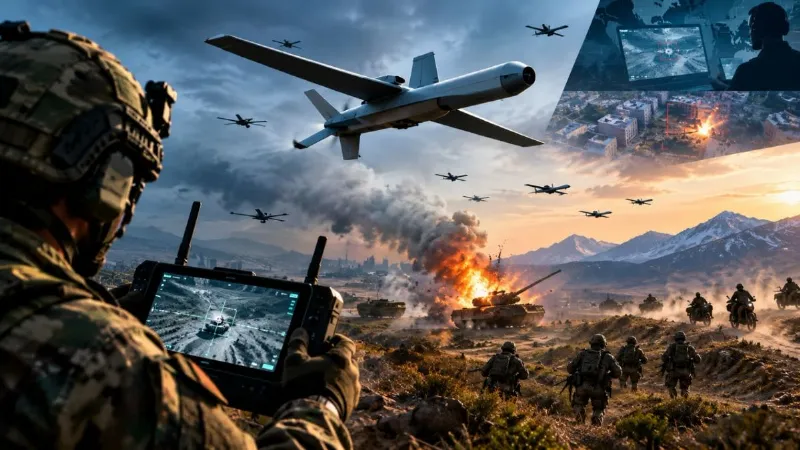


More than four years into the war in Ukraine, the deadliest weapon on the front is no longer the tank or the howitzer. It is a small, cheap machine flown by a soldier watching a screen several kilometres away. Kyiv says over 80 per cent of its battlefield hits are now delivered by drones, which struck some 820,000 targets in 2025 alone.
The effect shows in how armies move. Heavy armour has largely vanished from the front line. Russian assault groups now creep forward on motorcycles and on foot, in small groups, because anything larger is spotted and struck within minutes. The lesson is blunt: the battlefield has become transparent, and whatever can be seen can be hit.
Three Wars, One Pattern
Ukraine did not invent this shift; it industrialised it. In the 44-day Nagorno-Karabakh war of 2020, Azerbaijan used armed drones and loitering munitions first to blind Armenian air defences and then, working with artillery, to pick apart armour caught in the open. Armenia lost at least 224 tanks, a minimum count confirmed by photographs and video. Its ageing radars could not see small, slow aircraft, and it had no jammers to cut their control links.
West Asia has added a lesson in economics. In the first week of this year's war over Iran, which began on February 28, Tehran launched more than 2,000 one-way attack drones at Israel and the Gulf states. Each costs an estimated $20,000 to $50,000. The missiles fired to stop them cost $3 million to $12 million apiece. A defender who must stop every drone, while the attacker needs only a few to get through, can win the engagement and still lose the arithmetic.
Operation Sindoor: India's First Drone War
India had its own test in May 2025. Operation Sindoor, launched on May 7 after the Pahalgam terror attack that killed 26 civilians, hit nine terror sites in Pakistan and Pakistan-occupied Jammu and Kashmir without Indian troops crossing the border. Loitering munitions were part of the strike package. Poland's ambassador in New Delhi has since confirmed that India placed fresh orders for Warmate systems after their use in the operation.
Pakistan answered with swarms of drones and loitering munitions aimed at cities and bases from Jammu to Bhuj. Chief of Defence Staff Gen Anil Chauhan later said most were neutralised by kinetic and non-kinetic means, and none damaged military or civilian infrastructure. His larger point was that self-reliance in drones and counter-drone systems is now a strategic imperative.
Precision Strike at a Fraction of the Cost
Loitering munitions sit at the heart of this change. Part drone, part missile, they are carried by a small team and launched in minutes. They circle over an area and strike only when the operator confirms a target, or abort and search again. Precision strike once meant a fighter jet, a cruise missile or a guided shell, each scarce and costly. A man-portable loitering munition puts that power in the hands of an infantry section, and doubles as its eye in the sky.
For India, the question is no longer whether to field such weapons but where to make them. The Army inducted the Warmate under emergency procurement and has tested it from the plains to the heights of Ladakh.
WB India, part of the WB Group, now plans a production line for a tube-launched version in the Uttar Pradesh Defence Industrial Corridor, swapping imported components for Indian ones where they meet the standard. Combat-tested designs, adapted and built at home, are what a long war will demand. Some of this capability is already in service. WB Group's Warmate loitering munitions are with the Army and have been flown in trials in Ladakh. Teamed with the company's FlyEye reconnaissance drone, Warmate can strike targets about 100 km away, the sensor-to-shooter link on which Shaktibaan units are designed.
WB India can also tailor its designs to demanding environments and keep its systems serviced near the units that use them. Homegrown suppliers are expanding their contribution as well. Solar Defence and Aerospace Limited (SDAL) has supplied the Army with 450 Nagastra-1R loitering munitions in one batch, which it calls the largest single supply of its kind to the Army so far. On August 14, 2026, the Ministry of Defence also signed contracts in New Delhi, in the presence of Defence Secretary Rajesh Kumar Singh, with TATA Advanced Systems Limited and NIBE Private Limited for loitering munition systems, along with munitions and other accessories, for the Army, worth about ₹1,577 crore.
What India Must Do Next
Three priorities follow. The first is mass. Ukraine planned to build about 2.5 million small attack drones in 2025 alone, while Indian orders are still counted in the hundreds. Stocks must be sized for a war of weeks, not days, with production lines that can surge.
The second is affordable defence. Sindoor showed that India's layered air defences can blunt a short drone offensive, but no budget can answer cheap drones with costly missiles for long. Guns, jammers and interceptor drones must carry more of the load.
The third is doctrine. Every unit must learn both to use drones and to hide from them. The Army's post-Sindoor drills with offensive and counter-drone swarms are a sound start.
The unmanned battlefield is no longer a forecast. It is here, and the side that builds, adapts and replaces fastest will hold the edge.